Post-Accutane syndrome and relationships
Not sure how to tell a partner, or someone new, about post-Accutane syndrome (PAS)? Words you could use, and how to choose your moment.
Finding it hard to feel close to a partner since taking isotretinoin, the acne medicine sold as Accutane or Roaccutane? Post-Accutane syndrome (PAS) is when its side effects last after stopping. It can take away desire, feeling in the genitals and closeness.
Isotretinoin is often taken young. Experts advising the UK medicines regulator say use is likely to be highest between 15 and 25. So PAS can begin in the years people start dating. The leaflet in the pack doesn’t say how to talk to a partner about it.
Elliot took Roaccutane at 17. In his twenties, he says, relationships ended “because of not being able to feel connected”. From the outside, “it looked fine to people”. In this 90-second clip he talks about those years, and about starting to tell people.

You can explain it to a partner in a few plain sentences.
Can Accutane affect your relationship?
Yes, and many people only find out once they’re with someone. The UK leaflet lists a lower sex drive, erection problems, vaginal dryness, trouble reaching orgasm and less feeling in the genitals.
Side effects are “generally reversible”, it says, which means they usually wear off. But “some may continue after treatment has stopped”. Our pages on Accutane’s sexual side effects and on what women describe go through each one.
Many people told the UK experts they “did not appreciate the extent of their problems until they started to engage in sexual activities with partners”. Most didn’t know of a link to isotretinoin. So you may blame yourself, your partner or the relationship long before you think of an acne course that ended years ago.
Sexual problems can hurt self-esteem and relationships, the experts wrote. The risk to mental health may be “especially high”, they added, if the problems start just as people are getting confident about sex.
Several people who wrote to the review worried they’d never settle down with a partner. One wrote that it “ruined a long-term relationship I had in the beginning where both of us had thought we would get married”.
Feelings can change too. Elliot describes years when no emotion would “land”. Our page on emotional numbness after Accutane has what others say.
PAS is more than a sex problem. A checklist that doctors and researchers proposed in 2022 says it can also bring problems with concentration and memory, depression, and changes to the skin, joints and bowel. These can come with the sexual symptoms or on their own.
The story in 3 lines
- The UK Roaccutane leaflet reports “long-lasting sexual problems” that continued after people stopped isotretinoin.
- Experts advising the UK regulator heard from many people who only realised how bad it was once they had a partner (2023 report).
- We found no study of couples living with PAS (our search of medical research, October 2026).
Press: contact@sidefxhub.com
How do I explain PAS to my partner?
Keep it short, and start with what has changed. Then name it, and show them the line in the leaflet. That way it isn’t just your word.
Three things you could say
- What changed: “Since my acne medicine, I don't feel desire or closeness the way I used to”.
- That it isn't them: “It isn't something you've done”.
- Its name: “It's called post-Accutane syndrome. The leaflet in the pack says these problems can last”.
Then let them ask questions, and give them our PAS page to read in their own time.
Mention the parts that aren’t about sex too, such as low mood or trouble concentrating. A partner who hears only “sex” may take it personally.

People close to you may not see it at all.
Miriam took two courses of isotretinoin in her thirties. She links several problems to it, including an eye disease. Talking about that, she told Moral Medicine in 2025 that “the problem with this illness is that it’s invisible”. Her family, her former boyfriend and her friends “didn’t understand the severity of the illness”, she said.
When should I tell someone I’m dating?
When you trust them enough. That’s your call. Movember, a men’s health charity, says the same in a dating guide for men with erection problems after prostate cancer. What you share is “completely up to you”, it says. It admits there’s “not a lot of evidence” on how much telling helps.
It suggests sharing more as trust grows. Here’s what that could look like with PAS.
You don't owe anyone your medical history yet. Saying little or nothing is fine.
“A medicine I took left me with a health problem that affects sex. I'll tell you more when I'm ready”.
The name, the leaflet line, and what helps you now.
We think it’s easier to say it before you’re in bed together, so neither of you is caught off guard.
What can I do?
These medicines help many people. If you have side effects, that’s a decision for you and your prescriber.
If PAS is putting a strain on things, a counsellor can help you both talk. Our guide to finding a therapist covers couples counselling and what to tell them first. Others with PAS can help too: see our page on PAS support groups.
Tell your GP too. Bring a note like this: “Isotretinoin 20 mg a day from March 2019, last capsule October 2019. Since then: low sex drive, less feeling, struggling to concentrate. None of this before 2019”. Our page I think I have post-Accutane syndrome takes you through the appointment.
Report it: it helps everyone
A doctor’s note helps you. A report to the medicines regulator helps everyone else: it is how patterns get noticed.
- No proof needed. A suspicion is enough, even years after stopping. Your partner can help you fill it in.
- Where: the Yellow Card scheme in the UK, MedWatch in the US. Our guide to reporting isotretinoin side effects shows each step.
- Use the right words. PAS has no term of its own in the regulators’ dictionary (MedDRA) yet, so name each symptom and say it continued after stopping.
Our reporting guide walks you through it
What else do people ask?
Should my partner know I’m taking isotretinoin? The UK leaflet asks you to tell the people close to you, because it can affect your mood. You “may not notice some changes in your mood and behaviour”, it says, so “tell your friends and family that you are taking this medicine”. A partner may spot a change first.
Can a relationship survive PAS? Nobody can give you odds: we found no study of couples with PAS. Our page on PSSD and your partner has ideas for staying close when sex is hard, and many of them fit PAS too.
Is there something my partner can read? We haven’t written a page for partners of people with PAS yet. Our page for someone whose partner has PSSD answers the same first fear: “is it me?”. PSSD is a related condition that can last after some antidepressants.
Elliot spent years looking fine from the outside. In the last few years he’s started telling people, and telling himself the truth. When you’re ready, start with three plain sentences, and give your partner our PAS page.
Sources
- Roaccutane 10 mg soft capsules (isotretinoin), patient leaflet, electronic Medicines Compendium (EMC 100633), last revised April 2026, read 28 October 2026. Section 2: isotretinoin “has been associated with sexual problems. These include problems getting or maintaining an erection, lower libido, vaginal dryness, orgasm difficulties and reduced sensation in the genitals”. It adds: “There have been reports of long-lasting sexual problems where the symptoms have continued despite stopping treatment with isotretinoin”. Section 2, mental health problems: “You may not notice some changes in your mood and behaviour and so it is very important that you tell your friends and family that you are taking this medicine”. Section 4: “The side effects are generally reversible after changing the dose or stopping treatment, however some may continue after treatment has stopped”.
- Commission on Human Medicines, Report of the Isotretinoin Expert Working Group, 26 April 2023, published by the MHRA. Section 4.2.6: peak age range for Yellow Card reports of psychiatric side effects “is 15 to 25 years which reflects the age range where usage of isotretinoin would be highest”. Section 5.2, from the call for information: “Many did not appreciate the extent of their problems until they started to engage in sexual activities with partners. They generally did not know of a link between isotretinoin and certain types of sexual dysfunction”. Also: “Several expressed concerns about not being able to settle down with a partner or have children”. A comment, quoted as printed: “It also ruined a long-term relationship I had in the beginning where both of us had thought we would get married”. Section 5.3.6: the risk “may be especially high if sexual dysfunction occurs at an age when people are first gaining confidence and experimenting with their sexuality”. Comments are voluntary submissions: they show what people describe, not how often it happens.
- Healy D, Bahrick A, Bak M and colleagues. Diagnostic criteria for enduring sexual dysfunction after treatment with antidepressants, finasteride and isotretinoin. Int J Risk Saf Med 2022;33(1):65-76. Proposed criteria from an expert group, not an official diagnosis. Section 6 (post-retinoid sexual dysfunction): isotretinoin effects that “can occur independently of any sexual difficulties but may also accompany sexual problems” include cognitive impairment, skin, joint and bowel changes, and depression. The term post-Accutane syndrome “is in widespread use”.
- Movember, True North, How do I tell my date about my erectile dysfunction?, part of its guide to sex after prostate cancer, read 28 October 2026. It says: “So, what you decide to share is completely up to you”. And: “Unfortunately, there’s not a lot of evidence out there on how helpful disclosure is”. It moves from first dates to more consistent dating: “if you are developing more trust and intimacy, then consider more disclosure”.
- Moral Medicine, He Took Accutane at 17. His Life Never Returned to Normal., interview with Elliot, 28 January 2025, embedded here as an extract from 1:14:45 to 1:16:16. From the YouTube auto-captions: Roaccutane at 17 (3:45). At “23 or 24” (1:14:47), “I still haven’t had an emotion land” (1:14:55 to 1:14:59). Then “the relationships that came to an end because of not being able to feel connected” (1:15:12 to 1:15:17). “It looked fine to people” (1:15:45 to 1:15:46). “In the last two or three years is where I’ve really chosen to start telling people a bit more” (1:15:53 to 1:16:00); “tell myself the truth” (1:16:07 to 1:16:09). His story on our site: Elliot’s story.
- Moral Medicine, From Mild Acne to Severe Dry Eyes, Hair Loss and Infertility: Miriam’s Nightmare After Isotretinoin, interview with Miriam, 13 October 2025, quoted here from 30:03 to 30:18 (not embedded). From the YouTube auto-captions: “the problem with this illness is that it’s invisible”; “my family, my former boyfriend, my friends, they didn’t understand the severity of the illness” (30:11 to 30:18). Two courses, the first when she turned 30 (5:31, 8:58). Her story on our site: Miriam’s story.
- Our search: PubMed, 28 October 2026, for isotretinoin with partner, spouse, couple, relationship or dating, and for “post-Accutane”, “post-retinoid” or “post isotretinoin” (41 results in all). No study of partners or couples was found.
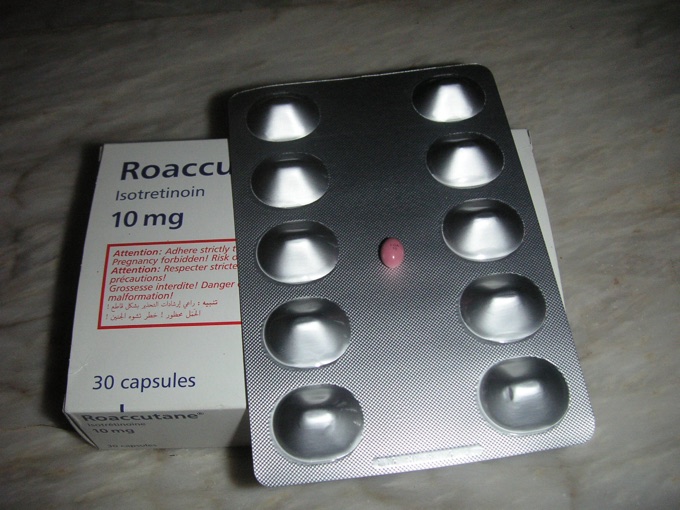
- Photo: Roaccutane.JPG, Jpogi and André Teixeira Lima, CC BY 3.0, via Wikimedia Commons.
Sources checked on 28 October 2026. AI-assisted writing and review, not clinical review.
640+ people have joined the registry.
Join them, then report your side effects.
Free. Sign up takes 2 minutes.