Why was Accutane discontinued in the US?
Roche stopped selling Accutane in the US in 2009, citing business reasons. Generics stayed, and in 2026 labels began to say sexual problems may last: PAS.
SIDEfxHUB is a patient charity. We are not health professionals, and this does not replace medical advice. Don't start, stop or change any medicine because of what you read here. Talk to your doctor first.
If you are in crisis:116 123 Samaritans (UK)988 Lifeline (US)Find a helpline
Roche, the company behind Accutane, stopped selling it in the US in 2009, saying the reasons were business ones, and the US regulator found it wasn’t pulled for safety. The medicine inside, isotretinoin, is still sold, and in 2026 its labels began to list sexual problems that may continue after stopping: post-Accutane syndrome (PAS).
PAS isn’t only about sex. Doctors and researchers who proposed a checklist for it in 2022 say the name often covers suicidal thoughts and problems with concentration and memory, sometimes with no sexual problems at all. If you’re struggling, the Samaritans are on 116 123 in the UK.
If you’ve taken isotretinoin in the US in recent years, it didn’t come from Roche. Until 2026, the official information with those capsules didn’t say sexual problems could last.
The story in 3 lines
- In June 2009 Roche told the US regulator it was stopping Accutane, for business reasons, it said (Irish Times).
- In July 2010 the regulator found it was “not withdrawn from sale for reasons of safety or effectiveness”. Generics stayed on sale (Federal Register).
- After an FDA request in June 2026, the Claravis label lists sexual problems “that may continue after discontinuation of treatment” (Claravis label). Patients call it PAS.
Press: contact@sidefxhub.com
Why was Accutane discontinued?
Roche said it was a business decision. In June 2009 it wrote to the US Food and Drug Administration (FDA), the government body that approves medicines, to say it was stopping Accutane, on sale there since 1982.
The Irish Times reported its statement on 30 June 2009. Accutane’s patent had run out, so other companies could sell copies, called generics. Roche’s share of the US market had dropped below 1 in 20.
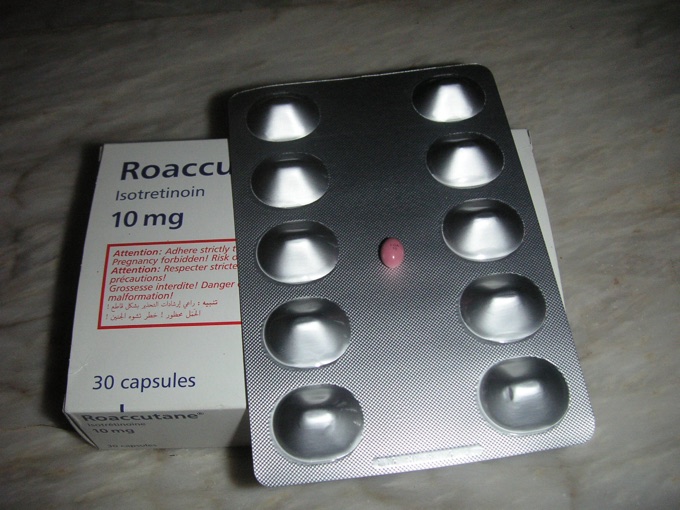
The statement also mentioned the high cost of personal injury lawsuits in the US, which Roche said it was still defending. Roche said it “stands behind the safety of Accutane”, and that it had no plans to stop selling it in Ireland, where it was called Roaccutane.
Was Accutane taken off the market because it was unsafe?
No. The FDA looked into it and said so in writing in July 2010: Accutane was “not withdrawn from sale for reasons of safety or effectiveness”.
It only looked because a company that makes generics asked. US rules don’t let it approve a copy of a medicine taken off sale for safety reasons.
It went through the research and the side-effect reports, and found no sign that safety was why Accutane was dropped. Then, in November 2010, at Roche’s request, it cancelled Accutane’s approval, its permission to be sold in the US.
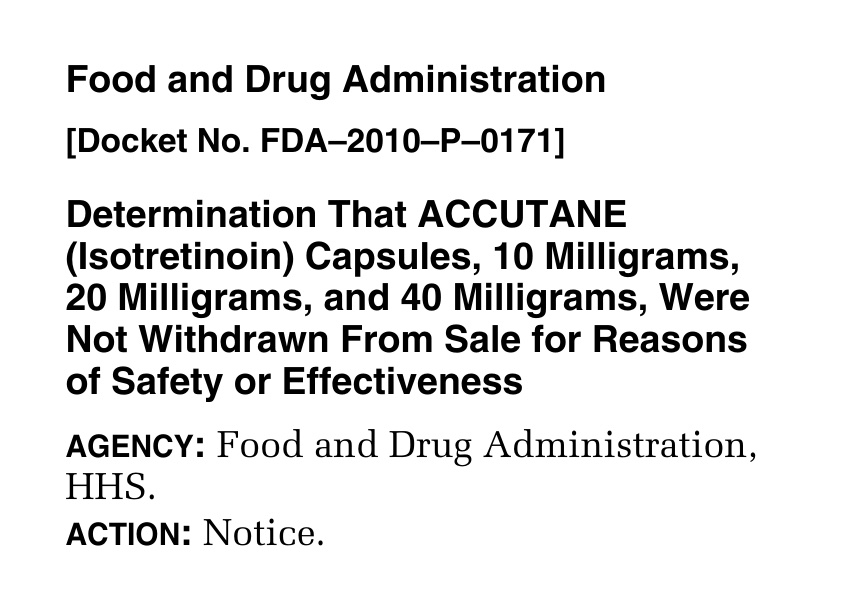
That finding is about why the brand left. It doesn’t say isotretinoin has no lasting side effects. Its labels in the US and the UK carry serious warnings, and our page on whether isotretinoin is safe goes through them.
Did the Accutane label change after 2009?
Not on sexual problems, until 2026. The label is the official information for doctors and patients, and a generic has to use the same words as the medicine it copies. So with Roche gone, the words stayed as Accutane’s last label left them in 2010. It listed one reproductive side effect, “abnormal menses”, meaning changes to periods.
Accutane in the US, 1982 to 2026
That 2010 label already said some side effects had lasted after stopping, such as hearing problems and poor night vision. Sexual problems weren’t on that list.
In 2010 the FDA had said it would tell generic makers if the label needed bringing up to date. Ten years later, a US law gave it the power to order those updates when the original medicine had left the market for reasons other than safety. In June 2026 it used that power for the first time.
Claravis, one of the generics, now lists sexual problems “that may continue after discontinuation of treatment”, meaning after stopping. Our 2026 label change article has more.
The name Accutane is back in the US too, on a generic from a company called JG Pharma. When we checked on 27 October 2026, its label still had the old wording, with nothing on sexual problems.
Dr Kenneth Peters is a urologist, a doctor for bladder and genital problems. In this extract he describes two patients he saw after Accutane: a student hoping to go to medical school, and a woman in her early thirties. Both developed numbness and other problems around the time they stopped.
Watch it to see PAS in two real people. It’s background only: he says nothing about Roche.


What can I do?
Isotretinoin helps many people with severe acne. If you have side effects, that’s a decision for you and your prescriber. The UK leaflet says to talk to your doctor about any sexual problems during treatment.
If problems have stayed since your course ended, take your dates and the name on the pack to your GP: “Claravis 40 mg a day from March 2022, last capsule September 2022.” Mention changes in mood, concentration or memory too.
Many people say it took time to be taken seriously, so bring the label line quoted above. You can report it yourself, without a doctor agreeing.
Report it: it helps everyone
A doctor’s note helps you. A report to the medicines regulator helps everyone else: it is how patterns get noticed.
- No proof needed. A suspicion is enough, even years after stopping.
- Where: the Yellow Card scheme in the UK, MedWatch in the US.
- Use the right words. PAS has no term of its own in the regulators’ dictionary yet, so name each symptom, such as genital numbness, and say it continued after you stopped isotretinoin.
Our reporting guide walks you through it
What else do people ask?
Is Accutane still sold in the US? The medicine is. Isotretinoin is sold as generics such as Claravis, Amnesteem and Zenatane, as a brand called Absorica, and as the JG Pharma generic named Accutane. None of them comes from Roche. All come under iPLEDGE, the US programme that aims to protect unborn babies.
Is Accutane discontinued in Canada or the UK? No. Canada still uses the name Accutane, and the UK uses Roaccutane, each now from a company other than Roche. The UK leaflet warns of “long-lasting sexual problems”, and the Canadian one says they “may continue after treatment”. Our page on isotretinoin warnings around the world compares countries.
Is post-Accutane syndrome real? It isn’t a formal diagnosis yet, and the 2022 checklist is only a proposal. But several US generic labels, such as Claravis, and the official information in the UK and Canada now say sexual problems can continue after stopping. Our article Is post-Accutane syndrome real? looks at the evidence.
If anything has felt different since your last capsule, whatever name was on the pack, report it. More about PAS is on our condition page.
Sources
- Irish Times, Eithne Donnellan, Acne drug withdrawn in US but business, not safety, issues cited, 30 June 2009. It gives Roche’s statement in reported speech. The US decision “was taken for business reasons and not for reasons of safety or efficacy”. Market share “had steadily declined to below 5 per cent since the drug came off patent, and generic alternatives became available”. The statement referred to “high costs from personal injury lawsuits”, which Roche “continues to defend”. Direct quote from the statement: Roche “stands behind the safety of Accutane”. Roche “had no plans to stop supplying the drug in Ireland”; marketed “as Accutane in the US and as Roaccutane here”. We could not find Roche’s own 2009 release online.
- US Food and Drug Administration, Determination that ACCUTANE (isotretinoin) capsules, 10 mg, 20 mg and 40 mg, were not withdrawn from sale for reasons of safety or effectiveness, Federal Register 75(129):39024, 7 July 2010, docket FDA-2010-P-0171. NDA 18-662, held by Hoffmann-La Roche, initially approved 7 May 1982, for severe recalcitrant nodular acne. “In a letter dated June 24, 2009, Roche notified FDA” that the capsules “were being discontinued”. Citizen petition from Sun Pharmaceutical Industries, 22 March 2010. Under 21 CFR 314.161 the FDA must decide whether a listed drug was withdrawn for safety or effectiveness before approving a generic (ANDA) that refers to it. The FDA “independently evaluated relevant literature and data for possible postmarketing adverse events”. “If FDA determines that labeling for isotretinoin capsules should be revised to meet current standards, the agency will advise ANDA applicants to submit such labeling.”
- FDA, Hoffmann-La Roche Inc.; Withdrawal of Approval of a New Drug Application, Federal Register, 22 November 2010, docket FDA-2010-N-0586. Roche stated the product was “no longer marketed” and asked for the approval to be withdrawn, effective 22 November 2010. “Isotretinoin continues to be marketed under approved abbreviated new drug applications”; the iPLEDGE REMS “remains in effect”.
- FDA, Drugs@FDA, NDA 018662, Accutane, last label (supplement 60, “Revised: January 2010”). Adverse reactions, Reproductive System: “abnormal menses” only. A generic’s labeling “must be the same as the labeling approved for the reference listed drug” (21 CFR 314.94(a)(8)(iv)). Warnings: hearing impairment “reported to persist after therapy has been discontinued”; decreased night vision “in some instances … persisted after therapy was discontinued”.
- FDA Center for Drug Evaluation and Research, Small Business and Industry Assistance, FDA Requests Labeling Updates for Generic Isotretinoin Products, 17 June 2026. It covers “all generic drugs referencing Accutane (isotretinoin) capsules”. “This is the first time FDA has used its authority under section 324 of the Consolidated Appropriations Act, 2021” (MODERN). The power applies to generics whose reference product was “withdrawn for reasons other than safety or effectiveness”. The bulletin itself lists “updates to adverse reaction descriptions” but does not name sexual side effects; the full reasoning is in the FDA’s response to citizen petition FDA-2018-P-4088, 16 June 2026 (regulations.gov would not open for this check on 27 October 2026), covered in our label change article.
- Claravis (isotretinoin), Teva Pharmaceuticals USA, US prescribing information, effective 22 July 2026, DailyMed, read 27 October 2026. Adverse reactions, Reproductive System: “Abnormal menses, sexual dysfunction that may continue after discontinuation of treatment (including erectile dysfunction, decreased libido, decreased vaginal lubrication, and vaginal dryness)”. Current DailyMed listings on 27 October 2026 also include Amnesteem (Mylan), Zenatane (Dr. Reddy’s; BluePoint) and Absorica and Absorica LD (Sun Pharmaceutical Industries); none of the 31 isotretinoin listings names Roche. The same line was in the Amnesteem, Absorica, Aurobindo and Dr. Reddy’s Zenatane labels updated August to September 2026; the BluePoint Zenatane label (April 2026) did not have it. The earlier Absorica label (DailyMed version 18, effective 12 June 2023) already listed “sexual dysfunction, including erectile dysfunction, decreased libido, decreased vaginal lubrication, and vaginal dryness”, without saying it may continue.
- Accutane (isotretinoin) capsules, JG Pharma, US prescribing information, effective 30 January 2026, DailyMed, read 27 October 2026. Approved as a generic (ANDA 202099); manufactured by Dr. Reddy’s Laboratories; “Distributed by: JG Pharma Inc., Scottsdale, AZ”; “Accutane is a registered trademark of JG Pharma, Inc. and/or its affiliates.” Adverse reactions, Reproductive System: “abnormal menses” only.
- FDA, iPLEDGE Risk Evaluation and Mitigation Strategy (REMS), content current as of 16 June 2026. “The goal of the iPLEDGE REMS is to mitigate the risk of embryo-fetal toxicity”; a “shared system” that “includes all FDA-approved isotretinoin products”.
- Healy D, Bahrick A, Bak M and colleagues. Diagnostic criteria for enduring sexual dysfunction after treatment with antidepressants, finasteride and isotretinoin. Int J Risk Saf Med 2022;33(1):65-76. Section 6 lists isotretinoin effects that “can occur independently of any sexual difficulties”: cognitive impairment, skin, joint and bowel changes, depression and suicidality. The name PAS “equally often appears to include suicidality and other cognitive effects without sexual difficulties”. Proposed criteria.
- Roaccutane 10 mg and 20 mg soft capsules, UK, Electronic Medicines Compendium (EMC 100633): patient leaflet, last revised April 2026, section 2; summary of product characteristics, revised 27 April 2026, section 7, marketing authorisation holder Neon Healthcare Limited. Read 27 October 2026.
- Accutane (isotretinoin capsules), Canada, product monograph including patient medication information, Cheplapharm Schweiz, date of revision 5 September 2025, Health Canada Drug Product Database. “There have been reports of persistence of these events following drug discontinuation”; patient information: “This may continue after treatment.” Read 27 October 2026.
- SIDEfxHUB, Interview with Dr. Kenneth Peters, PFS / PAS / PSSD Summit 2026, 25 April 2026. Extract 3:44 to 4:53, from the automatic captions. Two patients after Accutane, a pre-med student and a woman in her early 30s, developed numbness and other symptoms around stopping. Dr Peters is chair of urology at Corewell Health William Beaumont University Hospital, Michigan. The interview on our site: Dr. Kenneth Peters on the First PFS/PSSD/PAS Summit.
- Pictures: Roaccutane pack, File:Roaccutane.JPG, Jpogi and André Teixeira Lima, CC BY 3.0, Wikimedia Commons. Federal Register notice of 7 July 2010, cropped from the govinfo.gov PDF, US government work, public domain.
Sources checked on 27 October 2026. AI-assisted writing and review, not clinical review.
This information does not replace medical advice. Talk to your doctor before you make any decision about your treatment.
640+ people have joined the registry.
Join them, then report your side effects.
Free. Sign up takes 2 minutes.