Worried about PSSD? What to know
We found no way to tell who will get PSSD. A regulator says SSRI sexual side effects usually ease after stopping; UK leaflets warn they can continue.
SIDEfxHUB is a patient charity. We are not health professionals, and this does not replace medical advice. Don't start, stop or change any medicine because of what you read here. Talk to your doctor first.
If you are in crisis:116 123 Samaritans (UK)988 Lifeline (US)Find a helpline
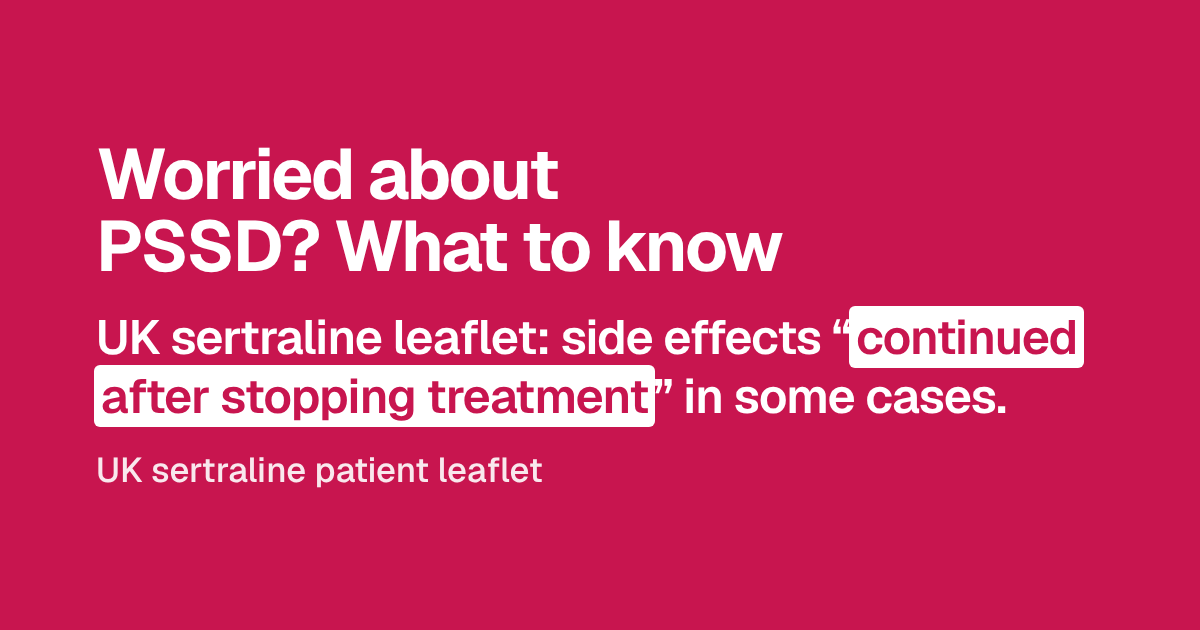
We found no test or study that can tell you in advance whether an antidepressant will leave you with post-SSRI sexual dysfunction (PSSD). New Zealand’s regulator says sexual side effects usually ease after stopping. UK leaflets warn they have sometimes continued: that’s PSSD.
PSSD is more than sexual problems. Its core is a lasting change in genital sensation, often numbness, and the 2022 criteria also describe emotional numbing, problems with thinking and changes in other senses.
Forums can make it sound like a certainty or a myth. The official documents are calmer, and they point to things you can do before your first tablet and during treatment.
The story in 3 lines
- Sexual side effects of SSRIs usually last as long as the medicine is taken and ease after stopping (New Zealand regulator, June 2026).
- The UK sertraline leaflet warns that in some cases they “have continued after stopping treatment”.
- No reliable figure exists for how often (2023 review), and we found no way to tell in advance who will be affected. Patients call it PSSD.
Press: contact@sidefxhub.com
Victoria was a university student when stress and sleepless nights took her to a doctor. When she was prescribed an antidepressant, she asked a question many readers of this page will recognise. The clip is worth 90 seconds because it shows what she asked, and what she says she was told.

She asked her doctor three times whether it was safe, she says. She remembers being warned about nausea and a little extra anxiety at the start, and nothing about effects that might last. She says she now lives with PSSD.
Will I get PSSD?
We found no way to tell you in advance. We searched PubMed on 21 October 2026 for a test or a proven predictor and found none. One review lists possible risk factors as ideas for research. The authors of the 2022 criteria note there is no biomarker, and that how often it happens is unknown.
One study gives an estimate. Researchers in Israel went through the health records of healthy men aged 21 to 49. They counted men who took an antidepressant acting on serotonin and were still prescribed erection tablets after stopping it. That was about 1 in 216 of the men who took one.
They counted only erection problems, in men, and say the true figure may be higher. No reliable figure exists for women, or for PSSD as a whole.
An online survey of people who said they had PSSD found most of the 135 who answered were young men. The authors also link it to relatively high doses. People chose to take part, though. New Zealand’s regulator says it isn’t known whether more men get PSSD, or whether men are simply more likely to report it.
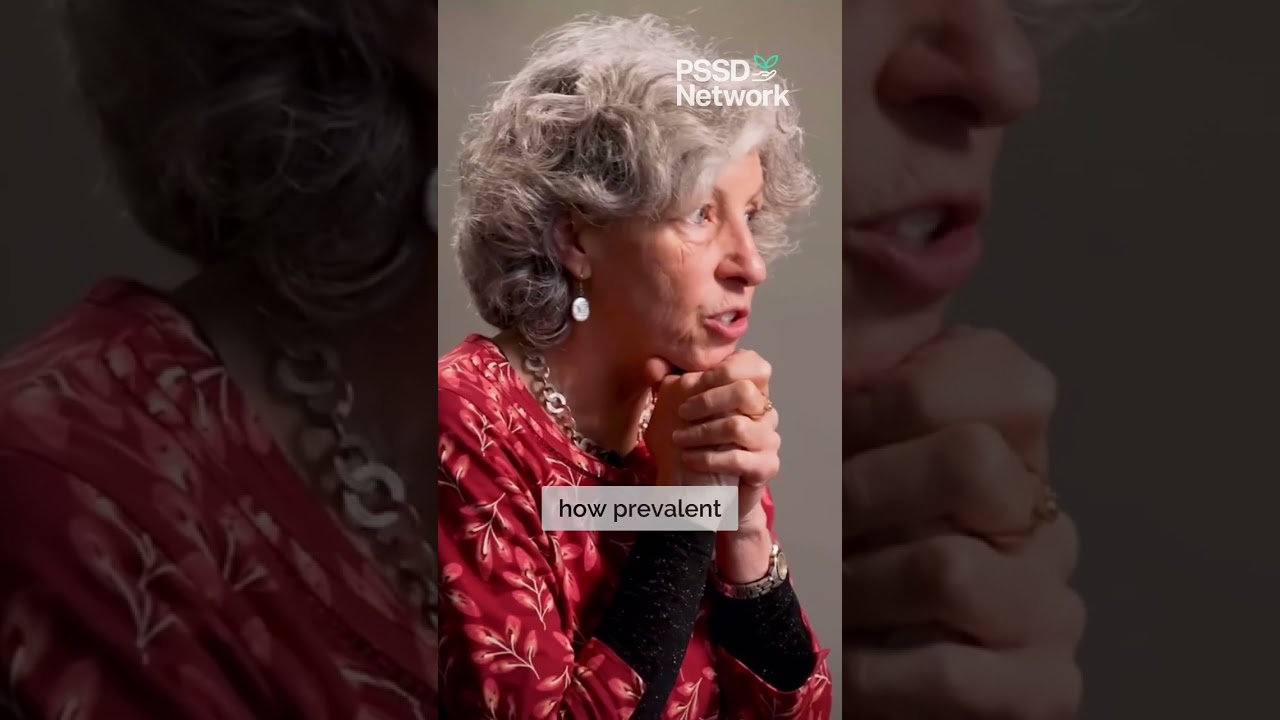
Joanna Moncrieff, a professor of psychiatry at UCL, says sexual problems while taking antidepressants are well established. Some people report that they carry on after stopping, she adds. Her short clip is background from a psychiatrist. It isn’t a patient’s account.
Are sexual side effects on the tablets an early sign of PSSD?
Not on their own. Sexual side effects of SSRIs are common, and they usually last only as long as the medicine is taken and ease after stopping, says a June 2026 paper by New Zealand’s medicines regulator.
PSSD is about what stays. The 2022 criteria look for problems still there at least three months after the last tablet. The one sign they require is a lasting change in how the genitals feel, such as numbness. Our page on when it counts as PSSD explains the timing.
Changes during treatment are still worth mentioning to your prescriber. In the online survey, most people who said they had PSSD had sexual symptoms while taking the medicine as well as after. A smaller group had them only after stopping.
Should I stop my antidepressant to be safe?
The NHS is clear about how to stop: “Do not stop taking an antidepressant suddenly or without talking to your doctor first.” That’s the line on its antidepressants page.
Stopping suddenly carries its own risk. The UK sertraline leaflet says withdrawal reactions are common, “particularly if the treatment is stopped suddenly”. It recommends lowering the dose gradually, over several weeks or months, and talking to your doctor about how.
In our PubMed search we found no study testing whether stopping early lowers the chance of PSSD. Withdrawal and PSSD are also different things, and our page on PSSD or withdrawal sets out how to tell them apart.
What can I do?
These medicines help many people. If you have side effects, that’s a decision for you and your prescriber. As the NHS says, don’t stop suddenly.
Before your first tablet, write down how sex is for you now. For example: “Sex drive normal, no numbness, orgasm fine, November 2026.” New Zealand’s regulator says a routine check of sexual function before and during treatment can give important information.
Three questions for your prescriber
- Which side effects should I tell you about straight away?
- What does the leaflet mean when it says sexual problems have continued after stopping?
- If I want to stop one day, how do we lower the dose safely?
You could start with: “I've read the leaflet and I have some questions before I start.”
Our guide to what to ask before starting has more. If something changes, tell them with your dates: “Sertraline 50 mg from January 2026, numbness since March.”
Report it: it helps everyone
A doctor’s note helps you. A report to the medicines regulator helps everyone else: it is how patterns get noticed.
- No proof needed. A suspicion is enough, even years after stopping.
- Where: the Yellow Card scheme in the UK, MedWatch in the US.
- Use the right words. If symptoms continued after stopping, write Post-SSRI sexual dysfunction (MedDRA 10086208).
Our reporting guide walks you through it
What else do people ask?
Could my anxiety be causing it? It can play a part. The NHS page on low sex drive lists stress, anxiety and depression among the main causes. The PSSD criteria ask what sex was like before the medicine, and our page on PSSD or depression looks at how doctors tell them apart.
Do SSRI sexual side effects always go away? New Zealand’s regulator says they usually ease after stopping. The UK leaflets warn that in some cases they have continued. Our article on whether SSRI sexual side effects go away covers what is known about recovery.
Is PSSD real? The UK leaflets for SSRIs warn about it, and it has its own medical term for reporting side effects. It isn’t in the diagnostic manuals yet. Our page Is PSSD real? sets out what each document says.
Victoria asked her doctor three times. You can ask too, with the leaflet line written down in front of you.
Sources
- Medsafe, Update on sexual dysfunction (post SSRI sexual dysfunction, PSSD) following discontinuation of serotonin reuptake inhibitors, paper for the Medicines Adverse Reactions Committee, 11 June 2026. Section 2.2 says sexual side effects of SRIs “usually persist for as long as the medicine is taken and resolve after discontinuation”. It adds that a routine review of sexual function “before and during treatment can provide important information”. Its comment on Patacchini 2021: “It is not known if PSSD is more prevalent in males, or more likely to be reported by them.”
- Lustral (sertraline) 50 mg and 100 mg film-coated tablets, patient information leaflet, Electronic Medicines Compendium (EMC 2835), last revised December 2025. Section 2, “Sexual problems”: “Medicines like Lustral (so called SSRIs) may cause symptoms of sexual dysfunction (see section 4). In some cases, these symptoms have continued after stopping treatment.” Section 2, “Withdrawal reactions”: they are common, “particularly if the treatment is stopped suddenly”. The dose is usually reduced gradually “over a period of several weeks or months”. Read 21 October 2026.
- NHS, Antidepressants, page last reviewed 12 June 2025. “Do not stop taking an antidepressant suddenly or without talking to your doctor first.” Common side effects include problems with sex, and “for some people, these problems may carry on after stopping antidepressants”. Read 21 October 2026.
- Healy D, Bahrick A, Bak M and colleagues. Diagnostic criteria for enduring sexual dysfunction after treatment with antidepressants, finasteride and isotretinoin. Int J Risk Saf Med 2022;33(1):65-76. The paper says “the incidence of these conditions is unknown”, and writes “in the absence of a biomarker”. PSSD criterion 2 is an enduring change in genital sensation after treatment stops. Criterion 6: present for at least 3 months after stopping. Criterion 7: no matching sexual problem before the drug. Section 3: ancillary non-sexual symptoms “may include” “emotional numbing”, “other sensory problems involving skin, smell, taste or vision” and “cognitive impairment”. Proposed criteria agreed by experts.
- Ben-Sheetrit J, Hermon Y, Birkenfeld S and colleagues. Estimating the risk of irreversible post-SSRI sexual dysfunction (PSSD) due to serotonergic antidepressants. Ann Gen Psychiatry 2023;22:15. Health records of healthy men aged 21 to 49 in one district of Clalit Health Services, Israel: 4 of 866 men treated with a serotonergic antidepressant (0.46%, “1 in every 216”) met the study’s case criteria for PSSD. A case was a man still being prescribed a PDE-5 inhibitor (erection medicine) after stopping the antidepressant; antidepressants included SSRIs, SNRIs and tricyclics. Erectile dysfunction only; the authors “acknowledge that it may underestimate the true prevalence of PSSD”.
- Tarchi L, Merola GP, Baccaredda-Boy O and colleagues. Selective serotonin reuptake inhibitors, post-treatment sexual dysfunction and persistent genital arousal disorder: a systematic review. Pharmacoepidemiol Drug Saf 2023;32(10):1053-67. Abstract: “It was not possible to determine reliable estimates of prevalence.”
- Patacchini A, Cosci F. Exposure to serotonin selective reuptake inhibitors or serotonin noradrenaline reuptake inhibitors and sexual dysfunction: results from an online survey. Int J Risk Saf Med 2021;32(3):229-42. 135 people who described themselves as affected by PSSD, 115 of them men, mean age 31.9. The syndrome was “more represented among young, heterosexual males” after “relatively high doses”. Of the 135, 118 had symptoms during and after treatment, and 17 only after. People chose to take part; there was no comparison group.
- NHS, Low sex drive (loss of libido), page last reviewed 26 May 2026. Main causes include “stress, anxiety or depression”.
- Moral Medicine, Victoria’s PSSD Story, interview with Victoria, 10 August 2026. Asked her doctor three times whether it was safe, from 5:25 to 6:03; warned of nausea and more anxiety at first, from 6:22. Extract played: 5:12 to 6:43. Her story on our site: Victoria’s story.
- PSSD Network, Professor Joanna Moncrieff discusses Post-SSRI Sexual Dysfunction (PSSD), June 2026. Paraphrased from the captions, 0:00 to 0:47. Extract played: 0:00 to 0:47.
- Our PubMed searches, 21 October 2026: (post-SSRI sexual dysfunction OR PSSD) with predict*, “risk factor*” or biomarker* (43 results), and with discontinu*, early or duration plus risk or prevent* (19 results). None tested a way to predict who gets PSSD, or whether stopping early lowers the chance. Peleg 2022 (Sex Med Rev, PMID 34627736) lists “presumed risk factors” as hypotheses.
This information does not replace medical advice. Talk to your doctor before you make any decision about your treatment.
620+ people have joined the registry.
Join them, then report your side effects.
Free. Sign up takes 2 minutes.