Hair thinning after Accutane: can it last?
Accutane (isotretinoin) can thin your hair. The UK leaflet calls it temporary, US labels say it sometimes persists. Lasting effects are called PAS.
SIDEfxHUB is a patient charity. We are not health professionals, and this does not replace medical advice. Don't start, stop or change any medicine because of what you read here. Talk to your doctor first.
If you are in crisis:116 123 Samaritans (UK)988 Lifeline (US)Find a helpline
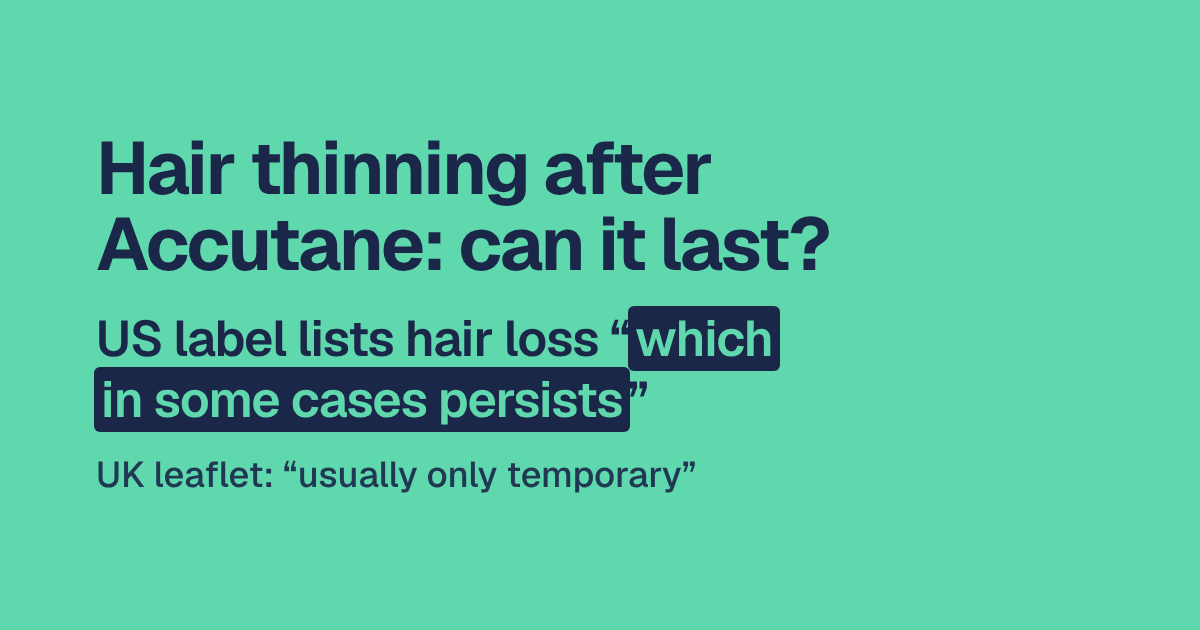
Accutane (isotretinoin) can make your hair shed and thin, and US labels say this “in some cases persists”. Symptoms that last after stopping are known as post-Accutane syndrome, or PAS, and some people count hair loss among them.
The UK leaflet says your hair “should return to normal after the treatment ends”. It also warns that some side effects “may continue after treatment has stopped”, so thin hair months later is worth raising.
PAS is more than one symptom. The criteria proposed in 2022 list problems with thinking, depression, and skin, joint and bowel changes alongside lasting sexual problems.
The story in 3 lines
- The UK leaflet (revised April 2026) lists hair loss as rare (up to 1 in 1,000 people) and “usually only temporary”.
- US labels for isotretinoin, as of October 2026, list hair loss “which in some cases persists”, with no length given (US label).
- A 2022 review looked at 22 studies on hair loss. Only 2 said whether it grew back, and it found “no definitive evidence” that it persists.
Press: contact@sidefxhub.com
Miriam took two low-dose courses of isotretinoin for mild acne, the first in 2020. On both, she says, her hair was “falling a lot”. In this short extract she describes how it changed, and what she has done since.
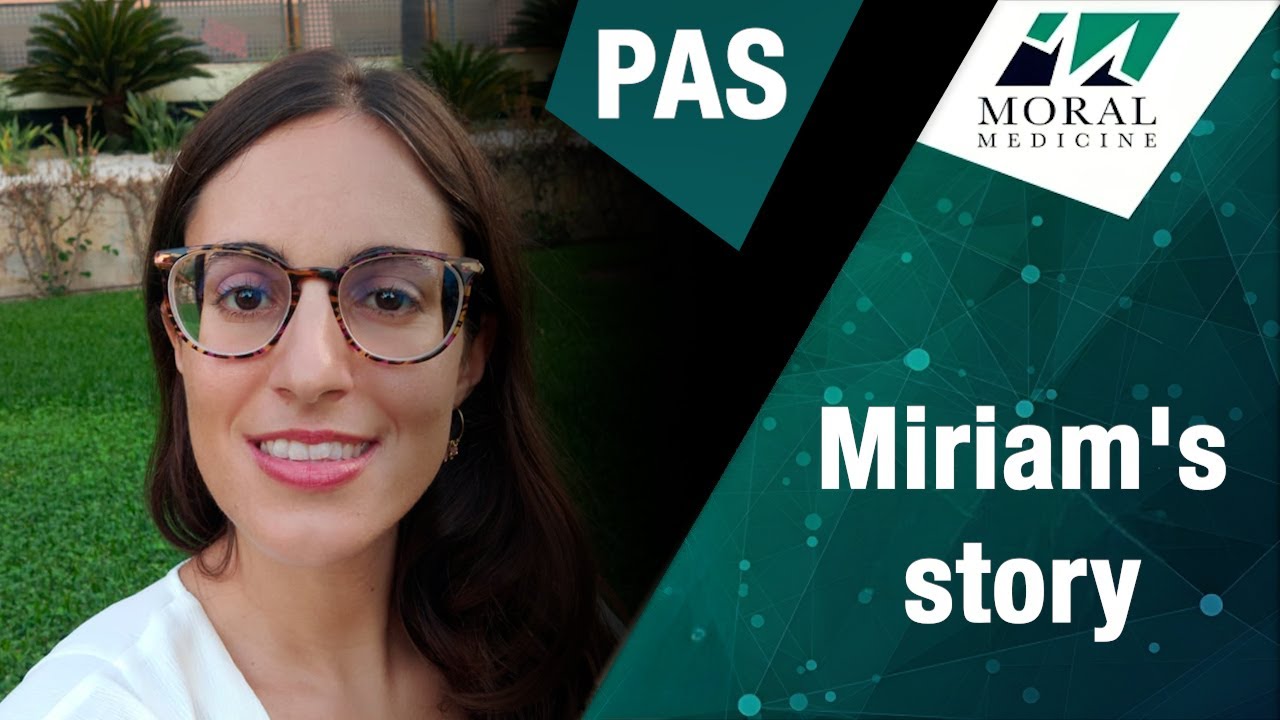
She has paid for treatments herself, and her hair has got better, she says. But it has changed. “It used to be greasy and now it’s very dry,” she says, and she has spoken to other women “who have had the same issue”.
How common is hair loss on Accutane?
Studies found it more often than the UK leaflet suggests. The leaflet calls it rare.
A 2022 review of 22 studies pooled the people whose hair loss was recorded, mostly as they reported it themselves. On higher doses it was about 6 in 100, and about 3 in 100 on lower doses. None of the studies it lists had a dummy-pill group to compare against.
Most of it is shedding that doctors call telogen effluvium. Retinoids such as isotretinoin are thought to push hairs into their resting phase early and loosen their hold, the review says, so more of them fall out.
Dr Emmy Graber, a dermatologist, uses the review’s figures when she counsels patients. Watch it for a doctor’s view of the shedding itself; it isn’t evidence about how long it lasts.

Can Accutane hair loss be permanent?
For some people it has lasted after stopping. Nobody knows yet who will be affected, or whether it will ease.
US labels list hair loss “which in some cases persists”. They don’t say for how long, or whether that means after the last capsule. The line sits in the small print for doctors, and the US Medication Guide that patients get doesn’t mention hair at all.
Research has barely asked. In the 2022 review, only 2 studies said whether hair grew back. One found it was temporary in the patients who lost hair on high doses; the other gave no data. The authors found “no definitive evidence” that it persists.
Dr Graber says she believes long-term loss after stopping is very rare. That’s her clinical view. We found no study that counted how often it lasts.
When does Accutane hair loss start?
Studies mostly describe it during the course. Not always, though.
Dermatologists at a Los Angeles university went back through their records. Of 48 patients diagnosed with hair loss who had taken isotretinoin, 19 had hair loss that began during the course or within two years after it. They had taken more of the drug, for longer, than patients without hair loss.
That matters if your hair started thinning after your last capsule. The drug itself leaves the body within weeks. How long does Accutane stay in your system? explains why that doesn’t settle whether the side effects have gone.
Hair loss and isotretinoin: what the documents and studies say
What can I do?
Isotretinoin helps many people with severe acne. If you have side effects, that’s a decision for you and your prescriber.
If your hair is shedding during a course, tell your prescriber. If it’s still thin months after the last capsule, see your GP and give your dates: “Isotretinoin 20 mg a day from March 2023, last capsule January 2024. Shedding from May 2023. Still thin all over in October 2024.”
Three questions for your GP
- Could this be shedding that should settle, or something else?
- Which other causes, such as thyroid or iron, have been checked?
- What's our next step if it hasn't improved in a few months?
You could start with: “My hair has been thin since isotretinoin. The US label says hair loss sometimes persists. Can we look into it?”
Many people say it took time to be taken seriously. You can report it without a doctor agreeing.
Report it: it helps everyone
A doctor’s note helps you. A report to the medicines regulator helps everyone else: it is how patterns get noticed.
- No proof needed. A suspicion is enough, even years after stopping.
- Where: the Yellow Card scheme in the UK, MedWatch in the US. There’s more in how to report isotretinoin side effects.
- Use the right words. PAS has no official MedDRA term yet. Write “hair loss”, give your dates, and say it continued after stopping.
Our reporting guide walks you through it
What else do people ask?
Does hair grow back after Accutane? The UK leaflet expects it to, and one small study found it was temporary in its patients. Miriam’s has improved but changed texture. If yours hasn’t, the US label line is the one to show your doctor.
Can Accutane change your hair texture? US labels list “hair abnormalities”, and the UK prescribing information lists “hair disorders”. Neither says what they look like. Miriam’s hair went from greasy to very dry. The UK leaflet also lists increased body hair.
Is hair loss part of post-Accutane syndrome? The 2022 criteria don’t name hair. They list lasting sexual problems with other effects, and note the name post-Accutane syndrome is “in widespread use”. Miriam counts hair loss among her symptoms. Long-term side effects of Accutane covers the others, and PAS support explains how to find people who have them.
Miriam now takes care of her hair, she says, “a lot, a lot”. If yours hasn’t come back since isotretinoin, report it with your dates.
Sources
- Roaccutane 10 mg soft capsules (isotretinoin), patient leaflet, Electronic Medicines Compendium (EMC 100633), UK. Last revised April 2026; read 21 October 2026. Section 4, rare (may affect up to 1 in 1,000 people): “Hair loss (alopecia). This is usually only temporary. Your hair should return to normal after the treatment ends.” Section 4, opening: “The side effects are generally reversible after changing the dose or stopping treatment, however some may continue after treatment has stopped.” Section 4, frequency not known: “Increased body hair.”
- Roaccutane 10 mg soft capsules, summary of product characteristics, EMC 100633, UK. Revised 27 April 2026. Section 4.8, skin and subcutaneous tissue disorders: alopecia; hair disorders. Section 4.8 also says side effects are generally reversible, “however some may persist after treatment has stopped”.
- Amnesteem (isotretinoin), US prescribing information, Mylan, DailyMed, US National Library of Medicine. Revised August 2026; read 21 October 2026. Section 6, adverse reactions identified in clinical trials or postmarketing reports, skin and appendages: “alopecia (which in some cases persists)” and “hair abnormalities”. The same wording is in the Accutane label (JG Pharma, revised September 2022). The line does not say how long hair loss lasted, or whether it continued after treatment stopped.
- Absorica and Absorica LD (isotretinoin), US prescribing information and Medication Guide, DailyMed. Revised August 2026; read 21 October 2026. Section 6: “alopecia (which in some cases persisted)”. As of October 2026, the Medication Guide does not mention hair.
- NHS, Isotretinoin (Roaccutane), page last reviewed 26 June 2026. As of October 2026, the page does not mention hair loss.
- Lytvyn Y, McDonald K, Mufti A, Beecker J. Comparing the frequency of isotretinoin-induced hair loss at <0.5-mg/kg/d versus ≥0.5-mg/kg/d dosing in acne patients: a systematic review. JAAD International, 2022; 6: 125–42. Read in full. 22 studies reported hair loss. Hair loss in 18 of 565 patients (3.2%) on under 0.5 mg/kg a day and 192 of 3,375 (5.7%) on 0.5 mg/kg a day or more; the groups could not be compared statistically. Only 2 studies discussed reversibility: one said hair loss was reported to persist after therapy, without data; a retrospective study found it temporary in 33 patients on high doses. The authors write that there is “no definitive evidence” that it persists after treatment. One study cited in the review found a median onset of 4 weeks (range 1 to 24 weeks). The review describes the proposed mechanism. Of the 22 studies, 17 used patients’ own reports of hair loss, 3 a dermatologist’s questions and 2 a scalp camera. We found no placebo group in the studies it lists. Our PubMed search on 21 October 2026 (isotretinoin with alopecia or hair loss, and persist, permanent or irreversible, in titles and abstracts) found 15 papers; none counted how often isotretinoin hair loss lasted.
- Tran PT, Evron E, Goh C. Characteristics of patients with hair loss after isotretinoin treatment: a retrospective review study. International Journal of Trichology, 2022; 14(4): 125–7. University of California, Los Angeles. Read in full (PMC9447463). Records of patients diagnosed with hair loss (ICD codes), 2013 to 2018. Of 6,330 patients with hair loss, 48 had been prescribed isotretinoin. In 19 of them hair loss occurred during treatment or within two years after; in 10, isotretinoin was used to treat the hair condition; in 19, hair loss came first. They were older, had higher cumulative doses and longer treatment than isotretinoin patients without hair loss.
- Healy D, Bahrick A, Bak M, and colleagues. Diagnostic criteria for enduring sexual dysfunction after treatment with antidepressants, finasteride and isotretinoin. International Journal of Risk & Safety in Medicine, 2022; 33(1): 65–76. Read in full. Other isotretinoin effects listed: cognitive impairment, skin changes, joint changes, bowel changes, depression, suicidality. Hair is not named. The paper says the name post-Accutane syndrome is “in widespread use”.
- Moral Medicine on YouTube, interview with Miriam, 13 October 2025, embedded here as an extract from 21:53 to 22:25. Her first course in 2020, at 5:25. Both courses low-dose, at about 8:05 to 11:30. Inside the extract: “alopecia, dry and thinning hair”. She paid for treatments, vitamins and hair products, and “thankfully it has gotten better”. On both courses her hair “was falling a lot”. “It used to be greasy and now it’s very dry.” She takes care of her hair “a lot, a lot now”. She has spoken to other women “who have had the same issue”. This is her account. Quotes are from YouTube’s automatic captions. Her story on our site: Miriam’s story: 2 courses of isotretinoin.
- H&W Global Alliance on YouTube, Isotretinoin and Hair Loss: What Do We Know?, 26 May 2026, 75 seconds. The speaker, Emmy Graber, MD, is named in the video’s description. She uses a systematic review’s dose figures to counsel patients about telogen effluvium, and says that in her view long-term persistence once isotretinoin is stopped is very rare. Paraphrased from YouTube’s automatic captions, read 21 October 2026. The video’s description calls the hair loss reversible; that is the channel’s wording.
This information does not replace medical advice. Talk to your doctor before you make any decision about your treatment.
620+ people have joined the registry.
Join them, then report your side effects.
Free. Sign up takes 2 minutes.