Who is researching PSSD, PFS and PAS?
Teams in six countries study PSSD, PFS and PAS, which can last after stopping a medicine. Who they are, what they found, and why most studies are small.
SIDEfxHUB is a patient charity. We are not health professionals, and this does not replace medical advice. Don't start, stop or change any medicine because of what you read here. Talk to your doctor first.
If you are in crisis:116 123 Samaritans (UK)988 Lifeline (US)Find a helpline
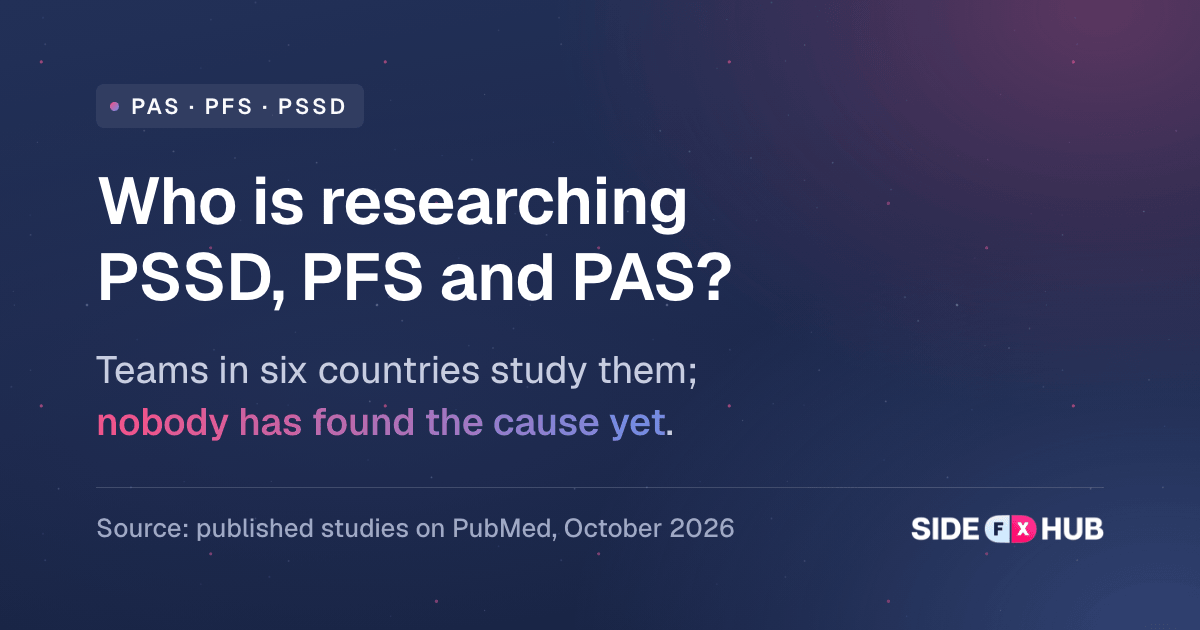
A small number of university and hospital teams, from Milan and London to Ottawa, Tel Aviv and Michigan, study post-SSRI sexual dysfunction (PSSD), post-finasteride syndrome (PFS) and post-Accutane syndrome (PAS). Each can last after stopping a medicine: an SSRI antidepressant, finasteride for hair loss, or isotretinoin (Accutane) for acne. Nobody has found the cause yet.
All three are more than sexual problems. A checklist that doctors and researchers proposed in 2022 also lists feeling emotionally numb and problems with concentration and memory, plus depression for PFS and PAS. If you live with one of them, it can feel as if nobody is looking. Some people are, but not many, and the work is still early.
The story in 3 lines
- In 2022, 37 doctors and researchers from 10 countries wrote one checklist for all three conditions. Several of the teams below helped write it.
- Most studies we found are small, and some found volunteers through patient groups (UK study, 2026).
- PAS has the least research we found. On 28 October 2026, three papers in PubMed, the US library of medical papers, used a name for it. For PFS, 67 did.
Press: contact@sidefxhub.com
Dr Kenneth Peters is a Michigan urologist, a specialist in the bladder and genitals. He began studying all three after four young patients came to him within two weeks with almost the same symptoms.
One had taken finasteride, one had PSSD, two had taken Accutane. In April 2026 he organised a medical conference on all three. Here he describes how alike their stories were.

Who is researching PSSD?
Since 2022, teams in at least six countries have published on PSSD:
- Canada: the University of Ottawa asked people what living with PSSD is like (2025). A British Columbia team ran a survey on genital numbness that lasted after stopping (2025).
- Israel: doctors in Tel Aviv used health records to estimate how often it happens in men (2023).
- Italy: the University of Milan gave rats paroxetine, another SSRI antidepressant, and checked their brains a month after the last dose (2025).
- The Netherlands: Lareb, where Dutch people report side effects, studied the PSSD reports it received (2022).
- UK: the University of East Anglia interviewed people living with PSSD (2026). A London team of nerve specialists measured genital numbness (2026). In Wales, David Healy, who led the 2022 checklist, has written about why PSSD is so hard to count (2024).
- US: a San Diego clinic went back through its records of men with PSSD, including tests of genital feeling (2025).
The Tel Aviv estimate is about 1 in 200 men who took these antidepressants. It’s based on prescriptions for erection tablets, so it says nothing about numbness, or about women.
Who is researching post-finasteride syndrome?
The PFS teams we found are mainly in Italy and the US, and they don’t all agree.
At the University of Milan, Professor Roberto Melcangi’s team tested the spinal fluid of men with PFS for chemicals that act on the brain (2017). In a 2026 animal study, rats showed signs of anxiety after their finasteride was stopped. Work in animals can hint at a cause, but it can’t prove one in people.
In Houston, a Baylor College of Medicine team compared which genes were switched on in skin cells from men with and without PFS (2021). In Udine and Trieste, Italy, researchers checked a gene that shapes how the body responds to male hormones (2017).
Dr Michael Irwig, a hormone specialist now at Harvard, was one of the first to study men with PFS. In this 2012 film he describes what they told him, and says he can’t put a number on the risk.

Not every team finds a link. A US team used insurance records to follow men from a big trial of finasteride to prevent prostate cancer, all 55 or over, for about two decades. It found no clear difference in the problems linked to PFS between men on finasteride and men on a dummy pill. The authors say this doesn’t support PFS.
Is anyone researching post-Accutane syndrome?
Very few teams. The only paper we found with “post-Accutane” in its title or summary is Dr Peters’ from 2025.
It isn’t ignored. The 2022 checklist covers it under another name, and Healy’s group has written up cases after isotretinoin. Dr Peters’ paper on all three looks at the nerves, including with a scan of the tiny nerves in the eye.
Our page on what PAS, PFS and PSSD share compares them.
When each condition reached the medical journals
What can I do?
These medicines help many people. If you have side effects, that’s a decision for you and your prescriber. If you take an antidepressant, don’t stop suddenly.
To take part in research, see our page on PSSD studies you can join. Our registry isn’t a study: it’s how we keep in touch, and we never share your data.
Four questions for any new study
- Who ran it, and when was it published?
- Was it in people or in animals?
- How many people took part, and how were they found?
- Is it a full paper in a journal, or a talk or a short summary?
To find new papers yourself, search PubMed for the full name, such as “post-SSRI sexual dysfunction” or “post-finasteride syndrome”.
Report it: it helps everyone
A doctor’s note helps you. A report to the medicines regulator helps everyone else: it is how patterns get noticed.
- No proof needed. A suspicion is enough, even years after stopping.
- Where: the Yellow Card scheme in the UK, MedWatch in the US.
- Use the right words. If symptoms continued after stopping, write Post-SSRI sexual dysfunction (MedDRA 10086208) for an SSRI or SNRI, or Post 5-alpha-reductase inhibitor syndrome (MedDRA 10082430) for finasteride. For isotretinoin there’s no term yet, so say the symptoms continued after stopping.
Our reporting guide walks you through it
What else do people ask?
Is anyone testing a treatment? Not in any registered trial. On 28 October 2026, ClinicalTrials.gov, a public register of trials, showed none for any of the three. Two of the teams above write that no effective treatment is available. If a study offers you a treatment, ask the four questions above and talk to your doctor.
Who pays for this research? Partly patient organisations. The PFS Foundation in the US has raised money for the Milan team’s PFS work. It says the Milano Project was launched in partnership with it and SIDEfxHUB, the charity behind this site. The PSSD Network, an Australian charity, supports Milan’s PSSD work and says it also backs researchers in Toronto and Washington.
How do researchers find people to study? Some go through patient groups. The East Anglia and Ottawa teams found volunteers that way, and Healy’s group studies reports sent to RxISK, a drug-safety website. People who come forward may be the most affected, the Houston team notes. So these studies can’t show how often the conditions happen.
Dr Peters started because four patients told him almost the same story. If you have PSSD, PFS or PAS, report it: Lareb’s study in the Netherlands drew on reports like yours.
Sources
- Healy D, Bahrick A, Bak M and colleagues. Diagnostic criteria for enduring sexual dysfunction after treatment with antidepressants, finasteride and isotretinoin. Int J Risk Saf Med 2022;33(1):65-76. Proposed criteria. 37 authors with affiliations in Canada, the US, the Netherlands, Italy, Germany, India, the UK, Poland, Spain and Slovakia (PubMed record 34719438), among them researchers from the Milan, San Diego, Boston, Houston and London teams named here. Ancillary symptoms include “emotional numbing” and “cognitive impairment” (PSSD), and cognitive impairment and depression, with or without sexual difficulties (finasteride, isotretinoin). History: PSSD “described in 2006”, PFS “described in 2011”, isotretinoin cases “reported in this journal in 2014”, designated post-retinoid sexual dysfunction “in 2018”. “The incidence of these conditions is unknown.”
- Brugi S, Budd B, Mackie C, Fish S. “It’s taken away the most fundamental things about being human”: the lived experience and impact of post-SSRI sexual dysfunction. Int J Qual Stud Health Well-being 2026;21(1):2717470. University of East Anglia, UK. Ten interviews; recruited “via the UK PSSD Association”.
- Chinchilla Alfaro K, van Hunsel F, Ekhart C. Persistent sexual dysfunction after SSRI withdrawal: a scoping review and presentation of 86 cases from the Netherlands. Expert Opin Drug Saf 2022;21(4):553-561. Netherlands Pharmacovigilance Centre Lareb; reports received 1992 to 2021. Abstract: “no effective treatment exists”.
- Rice EE, Kleinplatz PJ, Richardson HM and colleagues. Understanding the experiences of people with post-SSRI sexual dysfunction. J Sex Marital Ther 2025;51(5):447-461. University of Ottawa, Canada. Abstract: ten participants “recruited through a patient advocacy group”.
- Pirani Y, Delgado-Ron JA, Marinho P and colleagues. Frequency of self-reported persistent post-treatment genital hypoesthesia among past antidepressant users. Soc Psychiatry Psychiatr Epidemiol 2025;60(7):1771-1779. BC Centre for Disease Control, Simon Fraser University and the Canadian Post-SSRI/SNRI Sexual Dysfunction Society. Survey of sexual and gender minority youth aged 15 to 29 in Canada and the US. Abstract read.
- Ben-Sheetrit J, Hermon Y, Birkenfeld S and colleagues. Estimating the risk of irreversible post-SSRI sexual dysfunction (PSSD) due to serotonergic antidepressants. Ann Gen Psychiatry 2023;22:15. Clalit Health Services and Tel Aviv University, Israel. Records of 12,302 men aged 21 to 49; erectile dysfunction defined by prescriptions for PDE5 inhibitors. “The risk for PSSD was 1 in 216 patients (0.46%) treated with SAs.”
- Giatti S, Cioffi L, Diviccaro S and colleagues, Melcangi RC. Transcriptomic profile of the male rat hypothalamus and nucleus accumbens after paroxetine treatment and withdrawal. Mol Neurobiol 2025;62(4):4935-4951. University of Milan, Italy. Rats treated for 2 weeks, studied again at 1 month of withdrawal. Abstract read.
- Valnarov-Boulter I, Noronha A, Malladi P and colleagues, Panicker J. Genital sensory loss in persistent sexual dysfunction following SSRI exposure. International Continence Society 2026, abstract 302, 9 October 2026. National Hospital for Neurology and Neurosurgery, Queen Square, London. Conference abstract.
- Healy D, Mangin D. Post-SSRI sexual dysfunction: barriers to quantifying incidence and prevalence. Epidemiol Psychiatr Sci 2024;33:e40. Data Based Medicine, Wales, and McMaster University, Canada. Research “remains scarce owing to the difficulty in designing a suitable method”.
- Goldstein A, Goldstein S, Drian A and colleagues, Goldstein I. Sexual symptoms and biologic pathophysiologies of post-SSRI sexual dysfunction: a 15 year review. J Sex Med 2025;22(Suppl 4), abstract 313, doi 10.1093/jsxmed/qdaf320.309. San Diego Sexual Medicine, US. Conference abstract, published online November 2025: a retrospective chart review of men with PSSD, 2009 to 2024, including quantitative sensory testing (abstract read through Crossref; the journal page would not open). Described on our sensation studies page.
- Melcangi RC, Santi D, Spezzano R and colleagues. Neuroactive steroid levels and psychiatric and andrological features in post-finasteride patients. J Steroid Biochem Mol Biol 2017;171:229-235. University of Milan. Sixteen men with PFS; cerebrospinal fluid and plasma. Abstract read.
- Cioffi L, Diviccaro S, Chrostek G and colleagues, Melcangi RC. Finasteride withdrawal induces anxiety-like behavior and novelty avoidance in adult male rats. J Neuroendocrinol 2026;38(3):e70150. University of Milan. Abstract read.
- Howell S, Song W, Pastuszak A, Khera M. Differential gene expression in post-finasteride syndrome patients. J Sex Med 2021;18(9):1479-1490. Baylor College of Medicine, Houston, US. Penile skin cells from 26 men with PFS symptoms and 26 controls. Limitations include “potential selection bias arising from more severe phenotypes seeking care”.
- Cauci S, Chiriacò G, Cecchin E and colleagues. Androgen receptor (AR) gene (CAG)n and (GGN)n length polymorphisms and symptoms in young males with long-lasting adverse effects after finasteride use against androgenic alopecia. Sex Med 2017;5(1):e61-e71. Universities of Udine and Trieste, Italy. Abstract read.
- Irwig MS, Kolukula S. Persistent sexual side effects of finasteride for male pattern hair loss. J Sex Med 2011;8(6):1747-53. Dr Irwig’s recent work: a 2025 survey of dermatologists, Beth Israel Deaconess Medical Center and Harvard Medical School, Boston, US.
- Till C, Tangen CM, Goodman P, Unger JM, Thompson IM. No evidence of post-finasteride syndrome in 267,983 person-years follow-up in the Prostate Cancer Prevention Trial. Urology, published online 22 August 2026. Fred Hutchinson Cancer Center, Seattle, US. Medicare claims for 22 conditions “potentially attributed to PFS”; median follow-up 20 years; “none had a statistically significant association with treatment arm”. The trial: Thompson IM and colleagues, N Engl J Med 2003;349(3):215-24, men “55 years of age or older”, finasteride 5 mg a day or placebo for seven years. Abstracts read.
- Stachelek J, Zwaans BMM, Shtein R, Peters KM. Insights into the peripheral nature of persistent sexual dysfunction associated with post-finasteride, post-SSRI and post-accutane syndromes. Int Urol Nephrol 2025;57(8):2387-2394. Corewell Health William Beaumont University Hospital, Michigan, US. Three patients; corneal confocal microscopy and von Frey filament testing. “The underlying mechanism of this post-drug syndrome is unknown, nor is an effective treatment available.”
- Healy D, Le Noury J, Mangin D. Enduring sexual dysfunction after treatment with antidepressants, 5α-reductase inhibitors and isotretinoin: 300 cases. Int J Risk Saf Med 2018;29(3-4):125-134. Reports to RxISK.org, “a global adverse event reporting website”. Earlier: Hogan C, Le Noury J, Healy D, Mangin D. One hundred and twenty cases of enduring sexual dysfunction following treatment. Int J Risk Saf Med 2014;26(2):109-16.
- PubMed, US National Library of Medicine, title and abstract searches on 28 October 2026: “post-accutane” 1 paper (source 17); “post-retinoid” 2 papers (source 1, and Gül M and colleagues, Nat Rev Urol 2024); “post-isotretinoin syndrome” none; “post-finasteride syndrome” 67 papers. A count of papers that use the name, including papers that question the condition.
- ClinicalTrials.gov, US National Library of Medicine, searched 28 October 2026: no study listed under the condition “post-SSRI sexual dysfunction” or “post-finasteride syndrome”, and none mentioning “post-accutane” or “isotretinoin persistent sexual dysfunction”.
- PFS Foundation, news item “Team Melcangi launches ‘Milano Project’”, 11 April 2024. PFS Foundation, 2026 annual address, opened 28 October 2026: “Launched April 2024 in partnership with the PFS Foundation and SIDEfxHUB”. PSSD Network, home page, opened 28 October 2026: “we are actively supporting the research conducted by Dr. Melcangi et al. at the University of Milan”; “as of February 2025, we are expanding our support to include the research of Dr. Ashley Monks at the University of Toronto, and Dr. Antonei Csoka at Howard University, Washington D.C.” PSSD Network, About page: “a registered charity with the Australian Charities and Not-for-profits Commission”.
- SIDEfxHUB, Interview with Dr. Kenneth Peters, PFS / PAS / PSSD Summit 2026, April 2026, extract 2:56 to 5:06, paraphrased. Our write-up of the interview (August 2026) says he organised the conference in late April 2026.
- PFS Foundation, Persistent sexual side effects of finasteride (Propecia) for male pattern hair loss, Dr Michael Irwig, August 2012. Extract 0:00 to 1:45.
- MedDRA terms Post-SSRI sexual dysfunction, code 10086208, and Post 5-alpha-reductase inhibitor syndrome, code 10082430 (version 28.0).
Sources checked on 28 October 2026. AI-assisted writing and review, not clinical review.
This information does not replace medical advice. Talk to your doctor before you make any decision about your treatment.
640+ people have joined the registry.
Join them, then report your side effects.
Free. Sign up takes 2 minutes.