Antidepressants and young people: the numbers
For journalists covering antidepressants and under-25s in England: where the NHS figures come from, and what they can't tell you.
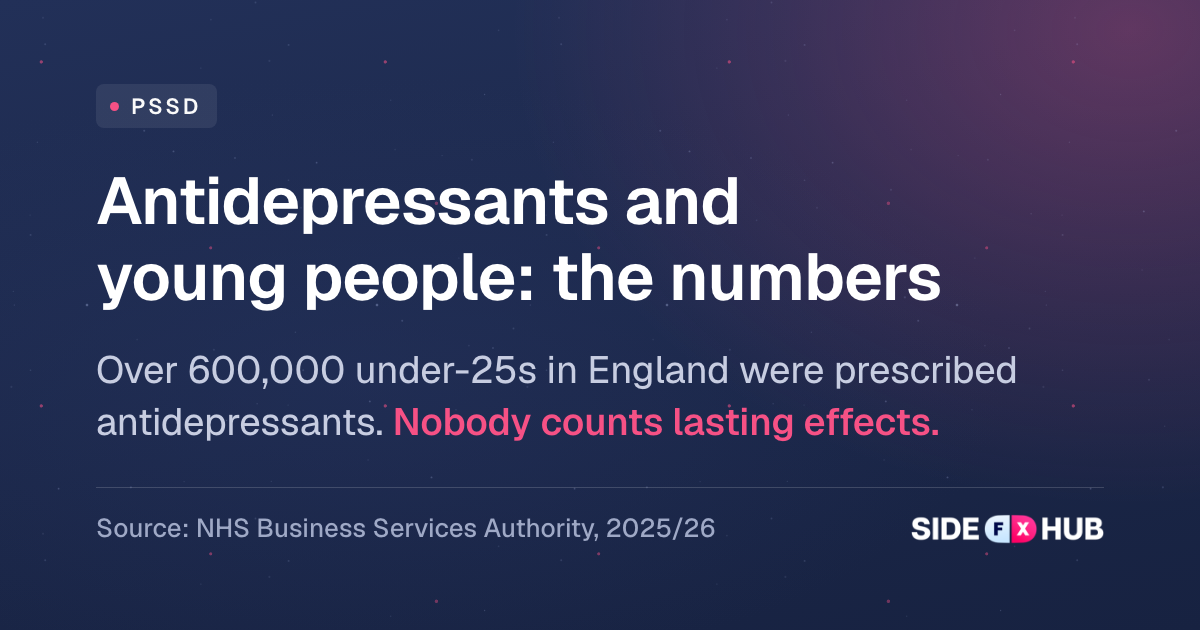
Writing about antidepressants and young people in the UK? More than 600,000 people under 25 in England were prescribed one on the NHS in 2025/26, by our sum of the official age bands. Nobody counts how many are left with sexual problems that continue after the last tablet.
That lasting change can be part of post-SSRI sexual dysfunction, or PSSD, and UK leaflets already warn it can happen.
Jevin was 11 when a psychiatrist started him on sertraline (Zoloft). “Mom didn’t know any better. I didn’t know any better,” he says. He was 26 when he told his story on camera, and he counts his PSSD from that first prescription.

The prescription numbers are public. The other number has never been collected.
How many young people in England take antidepressants?
The under-25 figure above comes from the NHS Business Services Authority, which published the 2025/26 data on 23 July 2026. It gives patients by age band, and we added up the bands under 25. Across all ages, about 9.1 million people got an antidepressant on the NHS that year.
Most of the under-25s were aged 20 to 24. The largest single group was much older: women aged 55 to 59.
Three limits matter if you quote it. It counts people given any antidepressant that year, for any reason, not only SSRIs. It leaves out private prescriptions and medicines handed out by hospital pharmacies. And it says nothing about when each person started.
Were young people asked about sexual side effects?
Not routinely. Two researchers in child and adolescent psychiatry at Columbia University looked at the large trials of these medicines in teenagers. “The trials did not routinely evaluate sexual symptoms and side effects,” they wrote in 2015. They knew of no questionnaire built to ask adolescents about sex.
In England, NICE guidance says under-18s with moderate to severe depression should be offered an antidepressant only alongside talking therapy, after a child and adolescent psychiatrist’s assessment. The young person and their parents “should be informed about” the “possible side effects”. The guidance doesn’t name sexual side effects among them.
Jevin says it was hard to tell when his own sexual symptoms began, because he was “going into puberty then”.
The UK fluoxetine leaflet, licensed for depression from age 8, warns that sexual symptoms “have continued after stopping treatment” in some cases. That paragraph names no age. For 8 to 18-year-olds it adds that fluoxetine “may slow growth or possibly delay sexual maturity”.
How many have sexual problems after stopping?
Nobody knows. “The incidence of these conditions is unknown,” say the 2022 diagnostic criteria, written by an international group of doctors and researchers.
A 2024 review sets out why it hasn’t been counted. Company studies don’t often follow people up to check for side effects that last, the authors say, and cases aren’t being properly recorded in medical notes. The prescription data counts tablets, not what happens afterwards.
PSSD is more than a sexual problem. The criteria describe a lasting change in genital sensation, often numbness, and say emotional numbing and problems with cognition can come with it.
In October 2026 the UK medicines regulator said the term PSSD will be added to the leaflets of ten antidepressants. Its notice gives no figure for how often it happens, and doesn’t discuss age. What regulators say about PSSD has the detail.
What can I do?
These medicines help many people. If you have side effects, that’s a decision for you and your prescriber. Don’t stop suddenly.
If you’re a journalist, quote the financial year and the publisher, and say that patient counts are estimates. Parents will find practical help in antidepressants in teens: sexual side effects.
Report it: it helps everyone
A doctor’s note helps you. A report to the medicines regulator helps everyone else: it is how patterns get noticed.
- No proof needed. A suspicion is enough, even years after stopping.
- Where: the Yellow Card scheme in the UK, MedWatch in the US. Parents and carers can report too.
- Use the right words. If symptoms continued after stopping, write Post-SSRI sexual dysfunction (MedDRA 10086208). Give the age when the medicine started, as well as today’s.
Our reporting guide walks you through it
What else do people ask?
How many children in England take antidepressants? About 63,600 aged 17 and under were prescribed one on the NHS in 2025/26. It was the first rise in child patients since 2021/22. Among 15 to 19-year-olds, most were girls.
Do the figures include private prescriptions? No. The NHS data covers prescriptions dispensed in the community in England. It doesn’t include private prescribers, prisons or hospital pharmacies.
Can Yellow Card reports show how common PSSD is? No. A report count is not a rate: it doesn’t say how many people took the medicine, or how many never reported. How to look up Yellow Card reports explains what the reports can tell you.
Do PSSD and the other syndromes start young? Some people, like Jevin, say theirs began young, but few records note the age when it started. Post-drug syndromes: do they start under 25? looks at the evidence.
Jevin was 11 at his first prescription and 26 on camera. If you report, give both your ages. Read more about PSSD.
Sources
- NHS Business Services Authority, Medicines Used in Mental Health, England, 2016/17 to 2025/26: antidepressant drugs (BNF section 4.3), published 23 July 2026. Read 6 November 2026. “In England in 2025/26: 96 million antidepressant items were prescribed to an estimated 9.1 million identified patients”. Also: “There were 63,600 identified patients aged 17 and under who received antidepressant prescribing in 2025/26, an increase of 1.6% from 2024/25. This is the first increase in child patients since 2021/22”. The summary adds that “71% of identified patients in the 15 to 19 age group were female”. It also says: “Female patients aged 55 to 59 were the largest group across all age and gender groups”. Table 4 (patients with known age and gender, 99.2%), 2025/26: aged 0 to 24, 624,463 in total, of whom 437,016 were aged 20 to 24. That sum is ours. Background notes, MUMH background, read 6 November 2026: the data covers prescriptions dispensed in the community; “Prescriptions issued in hospitals and fulfilled by the hospital pharmacy or dispensary are not included”. It “does not include data on medicines used in secondary care, prisons, or issued by a private prescriber.”
- NICE, Depression in children and young people: identification and management, guideline NG134, published 25 June 2019. Read 6 November 2026. Recommendation 1.6.14: “Do not offer antidepressant medication to a child or young person with moderate to severe depression except in combination with a concurrent psychological therapy.” 1.6.15: an antidepressant “should only be following assessment and diagnosis by a child and adolescent psychiatrist”. 1.6.17: the child or young person and their parents or carers “should be informed about the rationale for the drug treatment, the delay in onset of effect, the time course of treatment, the possible side effects, and the need to take the medication as prescribed”. The recommendations page does not mention sexual side effects.
- Levine A, McGlinchey E. Assessing sexual symptoms and side effects in adolescents. Pediatrics 2015;135(4):e815-7. A commentary by a psychiatrist (MD) and a researcher (PhD) in the Division of Child and Adolescent Psychiatry, Columbia University. Read 6 November 2026. Of large multisite placebo-controlled trials in adolescents (including the Treatment for Adolescents With Depression Study): “the trials did not routinely evaluate sexual symptoms and side effects.” “To our knowledge there are no assessment tools specifically for adolescents that address sexual issues.”
- Fluoxetine 20 mg hard capsules, patient leaflet (UK), Brown & Burk UK Ltd, Electronic Medicines Compendium (EMC 15755), last revised September 2022. Read 6 November 2026. Section 1: for children and adolescents aged 8 and above with moderate to severe depression. Section 2, “Sexual dysfunction”: “Medicines like Fluoxetine (so called SSRIs) may cause symptoms of sexual dysfunction (see section 4). In some cases, these symptoms have continued after stopping treatment.” The paragraph names no age. Section 4, children and adolescents (8 to 18 years): “Fluoxetine may slow growth or possibly delay sexual maturity.”
- Healy D, Bahrick A, Bak M and colleagues. Diagnostic criteria for enduring sexual dysfunction after treatment with antidepressants, finasteride and isotretinoin. Int J Risk Saf Med 2022;33(1):65-76. Read 6 November 2026. Introduction: “The incidence of these conditions is unknown.” Section 3, PSSD: “An enduring change in somatic (tactile) or erogenous (sexual) genital sensation after treatment stops”; “Ancillary non-sexual symptoms may include: emotional numbing”, with cognitive impairment. Proposed criteria from expert agreement.
- Healy D, Mangin D. Post-SSRI sexual dysfunction: barriers to quantifying incidence and prevalence. Epidemiol Psychiatr Sci 2024;33:e40. Read 6 November 2026. PSSD occurs “in an undetermined number of patients”; “Pharmaceutical company studies do not often include follow-up to check for enduring side effects”; “these cases are not being properly recorded in the medical notes”.
- MHRA, Antidepressants: new safety measures for all patients to improve communication of the risk of suicidal thoughts and behaviours and persistent sexual dysfunction, Drug Safety Update volume 20, issue 3, 15 October 2026. Read 6 November 2026. “The term “Post SSRI Sexual Dysfunction” (“PSSD”) will be added to the PILs of antidepressants associated with a risk of sexual dysfunction that may continue even after the drug is stopped”. Footnote 1 lists ten medicines. The notice gives no frequency figure and does not discuss age.
- Moral Medicine, 15 Years of Suffering: Jevin’s Battle with PSSD, 1 July 2024 (41 minutes; the title is the channel’s), embedded here from 3:39 to 4:11. From the YouTube auto-captions. “It starts at age 11 so I’m 26 now”, counted as 15 years (0:00 to 0:07). At 11 he saw a psychiatrist and started Zoloft (3:39 to 4:00). “Mom didn’t know any better I didn’t know any better” (4:07 to 4:11). Many other medicines followed, “all the way up until about 25” (4:23 to 4:39). On when sexual symptoms began: “it’s kind of hard to tell really … I’m going into puberty then” (8:20 to 8:34). His story on our site: Jevin’s story: first prescribed at 11.
- MHRA, Yellow Card scheme, How to report. Read 6 November 2026. The scheme relies on reports “by the public (including patients, parents, and carers)”. “You can report for yourself or for someone else, with their permission.”
- MedDRA term Post-SSRI sexual dysfunction, code 10086208.
Sources checked on 6 November 2026. AI-assisted writing and review, not clinical review.
640+ people have joined the registry.
Join them, then report your side effects.
Free. Sign up takes 2 minutes.