Yellow Card reports of PSSD: the numbers
Writing about PSSD and need the UK report figures? What the MHRA's counts show, what they can't show, and why one more report still matters.
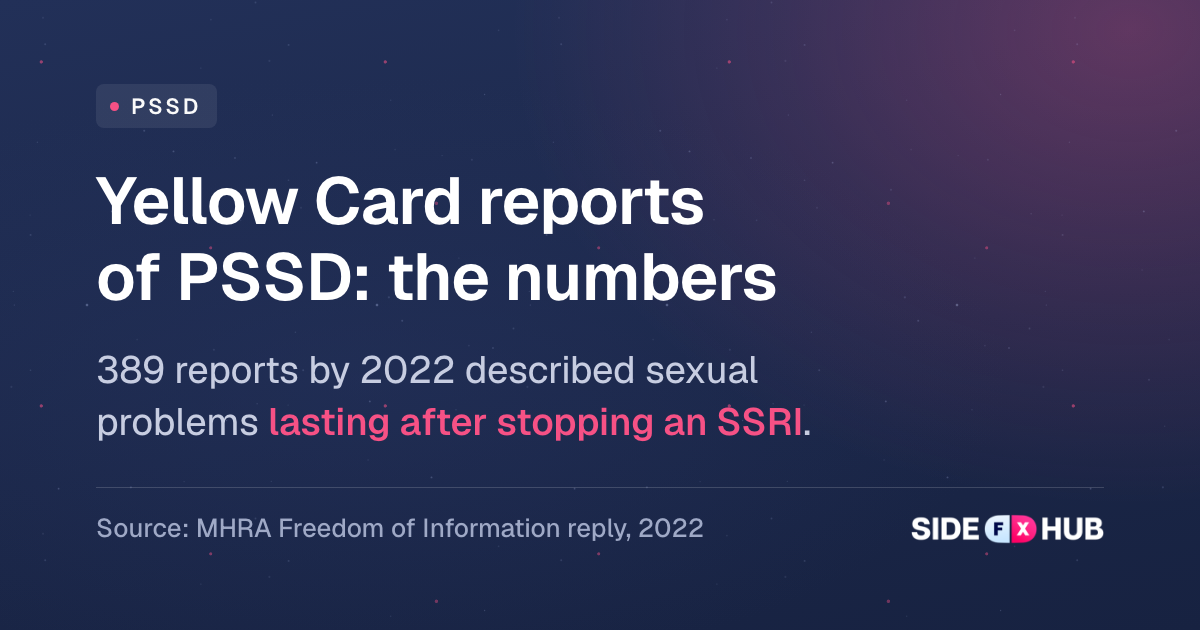
Looking for how many people in the UK have reported PSSD? The most recent public count we could find, from 2022, is 389 Yellow Card reports in which sexual problems on an SSRI antidepressant carried on after stopping. They were among 1,762 UK reports of sexual problems on SSRIs held by the MHRA, the UK medicines regulator.
When the problems last after stopping, the condition is called post-SSRI sexual dysfunction (PSSD). It’s more than sex: criteria proposed in 2022 also describe emotional numbing and problems with cognition. The count sounds small for medicines millions of people take. The MHRA says counts can’t show how common a side effect is.
Daryl had lived with PSSD for 13 years when he was interviewed in 2024. Watch this extract for what he says doctors told him afterwards. Two researchers argue that how doctors respond is one reason PSSD is so hard to count.

The number is low for reasons that may have little to do with how common PSSD is.
How many Yellow Card reports of PSSD are there?
The most recent public figure covers UK reports received up to 7 September 2022. The MHRA gave it in a Freedom of Information reply that month, after someone asked.
Of the 1,762 reports of sexual problems on an SSRI, 389 said the problem had carried on after the medicine was stopped. Most of the others didn’t say either way. Some people were still taking the SSRI. The boxes about stopping and outcome aren’t compulsory either, and left empty they count as unknown.
The count is hard to repeat by searching for the name. The term Post-SSRI sexual dysfunction has been on the Yellow Card form only since February 2022. The government told Parliament that older reports aren’t recoded: they stay filed under the symptoms people described.
We couldn’t find a newer published breakdown when we checked on 6 November 2026. Our guide to looking up a medicine’s Yellow Card data shows how to search the public profiles yourself.
Why is the number so small next to prescriptions?
Because a count only includes people who spoke up, and speaking up about sex is hard.
For a sense of scale, about 9.1 million people in England were prescribed an antidepressant in 2025/26 alone, NHS figures show. The two figures cover different years, areas and medicines, so they can’t be turned into a rate. The MHRA says report numbers “should not be used as a basis for determining the incidence of a reaction”.
Two doctors who study PSSD, David Healy and Dee Mangin, set out in 2024 why it’s so hard to count. People can feel too embarrassed to raise sexual problems. Doctors don’t routinely ask whether sexual side effects cleared up after stopping, so a case comes to light only if the person makes the link and feels able to say so.
Some people say they were dismissed when they did. Healy and Mangin write that many then stop seeing doctors about it, so their cases drop out of medical records. Others never connect their symptoms with a medicine they’ve already stopped.
The MHRA itself says a count can’t settle the question. In a 2023 reply it said finding out how common PSSD is would need a proper study.
Do Yellow Card reports about PSSD change anything?
Yes, and 2026 shows how. When the MHRA’s advisers reviewed antidepressant leaflets, they added two medicines, amitriptyline and nortriptyline, to the list whose leaflets will name PSSD. They picked them “based on the review of Yellow Card data”, the MHRA’s report says.
Before this, those two weren’t among the antidepressants that had carried a warning since 2019 about sexual problems continuing after stopping. The other eight on the list were.
On 2 November 2026 the government told Parliament the warning applies only where there is “sufficient supporting evidence from available sources, including Yellow Card reports and published scientific literature”. Reports are part of the evidence the regulator weighs when it decides which leaflets change.
A single report proves nothing on its own. The MHRA calls each one “only a suspicion by the reporter”. Together, they’re how patterns get noticed.
What can I do if I think I have PSSD?
These medicines help many people. If you have side effects, that’s a decision for you and your prescriber. Don’t stop suddenly.
If you think you have PSSD, you can report it yourself, without a doctor agreeing. Fill in the optional boxes about stopping, because that’s what was missing from so many past reports. For example: “Sertraline 50 mg from January 2023, last tablet March 2024. Genitals still numb in October 2026.”
Report it: it helps everyone
A doctor’s note helps you. A report to the medicines regulator helps everyone else: it is how patterns get noticed.
- No proof needed. A suspicion is enough, even years after stopping.
- Where: the Yellow Card scheme in the UK, MedWatch in the US.
- Use the right words. If symptoms continued after stopping, write Post-SSRI sexual dysfunction (MedDRA 10086208).
Our reporting guide walks you through it
Our step-by-step article covers the Yellow Card form for PSSD, and our guide explains why reporting side effects matters.
What else do people ask?
Can I see the latest PSSD count myself? Partly. The MHRA’s public profiles list reports for each medicine, and you can search them by symptom or term. The filters the MHRA lists don’t include whether a problem continued after stopping. To ask that, you can send a Freedom of Information request, as someone did in 2022.
So how common is PSSD? Nobody has measured it yet. The MHRA’s 2026 review found that evidence on the size of the risk “remains limited”. One reason it gives is that PSSD has no specific diagnosis in the main disease classifications.
Should I report symptoms that aren’t sexual? Yes. Patients told the MHRA’s advisers about non-sexual symptoms too, including slowed cognition. Put everything you’ve noticed in your report, with when each one started.
The 2022 count stood at 389. The next one can only include the reports people send.
Sources
- MHRA, FOI 22/938, letter of 28 September 2022, published 17 January 2024. Read 6 November 2026. Up to and including 7 September 2022: 1,762 UK spontaneous suspected reports of sexual dysfunction with an SSRI. Of these, 389 (245 + 144) “indicate that the sexual dysfunction persisted after discontinuation of the drug”. In 232 it did not continue. 1,135 were “UNKNOWN whether the reaction continued after drug withdrawn”, a group that “will also include cases where the patient has continued treatment”. “Action taken with drug” and reaction outcomes “are not mandatory fields”. Reports are “only a suspicion by the reporter”; the number of reports “should not be used as a basis for determining the incidence of a reaction”.
- UK Parliament, written question HL11843, asked by Lord Alton of Liverpool on 12 November 2025, answered by Baroness Merron on 25 November 2025. Read 6 November 2026. The term was added to MedDRA as a lower-level term in version 24.1 and made available on the Yellow Card website in February 2022. Reports “are not recoded” and “remain as reported with the terms selected by the original reporter”.
- NHS Business Services Authority, Medicines used in mental health, England, 2016/17 to 2025/26, published 23 July 2026. Read 6 November 2026. “96 million antidepressant items were prescribed to an estimated 9.1 million identified patients” in England in 2025/26. Community dispensing only; excludes secondary care, prisons and private prescriptions. Not comparable with the UK report count in source 1.
- Healy D, Mangin D. Post-SSRI sexual dysfunction: barriers to quantifying incidence and prevalence. Epidemiol Psychiatr Sci 2024;33:e40. Editorial (commentary, not a study). Read 6 November 2026. Obstacles include “patient embarrassment at raising sexual concerns” and “the response of healthcare professionals”. Another is “patient unawareness that their sexual difficulties are linked to prior medication”. Doctors “do not routinely enquire about the resolution of sexual side effects after stopping”. Patients “often stop consulting healthcare professionals”, so “these cases disappear from clinical practice and records”. The authors declare links to RxISK.org.
- MHRA, response to FOI 23/059, 19 April 2023. Read 6 November 2026. “The frequency of suspected side effects cannot be estimated using spontaneous data”. Also: “A robust study would be needed in order to establish the prevalence of PSSD”. Reporting “is voluntary by prescribers and patients”.
- MHRA, Antidepressants: updated safety communications, Public Assessment Report, 15 October 2026. Read 6 November 2026. Recommendation 21: the PSSD term should apply to antidepressants with current warnings. It should also apply to “the additional antidepressants identified as having a potential association based on the review of Yellow Card data (amitriptyline and nortriptyline)”. Literature review: “Evidence on the magnitude of the risk remains limited”. The reason given, in part: there is “no specific diagnosis” for PSSD in ICD-11 or DSM-5. Patients reported non-sexual symptoms including “cognitive slowing”.
- MHRA, Antidepressants: use and safety, updated 15 October 2026. Read 6 November 2026. The 2019 review covered duloxetine, venlafaxine, citalopram, escitalopram, fluoxetine, fluvoxamine, paroxetine and sertraline; the 2026 PSSD wording applies to those eight plus amitriptyline and nortriptyline. “In addition to sexual symptoms patients also reported non-sexual symptoms.”
- UK Parliament, written question HL4193, asked by Lord Alton of Liverpool on 19 October 2026, answered by Baroness Merron on 2 November 2026. Read 6 November 2026. “The EWG’s recommendation to include a warning on “PSSD” applies only to those antidepressants for which there is sufficient supporting evidence from available sources, including Yellow Card reports and published scientific literature.”
- MHRA, response to FOI 24/168, 18 March 2024. Read 6 November 2026. Profile filters: “age (10 year bands), sex, route of administration, report seriousness, year received, and source of report”. “The likelihood of experiencing an adverse drug reaction when taking a medicine cannot be estimated from the data”.
- Healy D, Bahrick A, Bak M and colleagues. Diagnostic criteria for enduring sexual dysfunction after treatment with antidepressants, finasteride and isotretinoin. Int J Risk Saf Med 2022;33(1):65-76. Proposed criteria. Ancillary non-sexual symptoms “may include” “emotional numbing” and “cognitive impairment”.
- Video: Moral Medicine, 13 Years of Post SSRI Sexual Dysfunction (PSSD), interview with Daryl, 17 October 2024, embedded as an extract from 1:11 to 9:26.
Sources checked on 6 November 2026. AI-assisted writing and review, not clinical review.
640+ people have joined the registry.
Join them, then report your side effects.
Free. Sign up takes 2 minutes.