Leaflet side effects: “common” is up to 1 in 10
On a UK leaflet, “common” means up to 1 in 10 people. “Not known” means no figure. It doesn't mean rare. No reliable figure exists for PSSD, PFS or PAS.
SIDEfxHUB is a patient charity. We are not health professionals, and this does not replace medical advice. Don't start, stop or change any medicine because of what you read here. Talk to your doctor first.
If you are in crisis:116 123 Samaritans (UK)988 Lifeline (US)Find a helpline
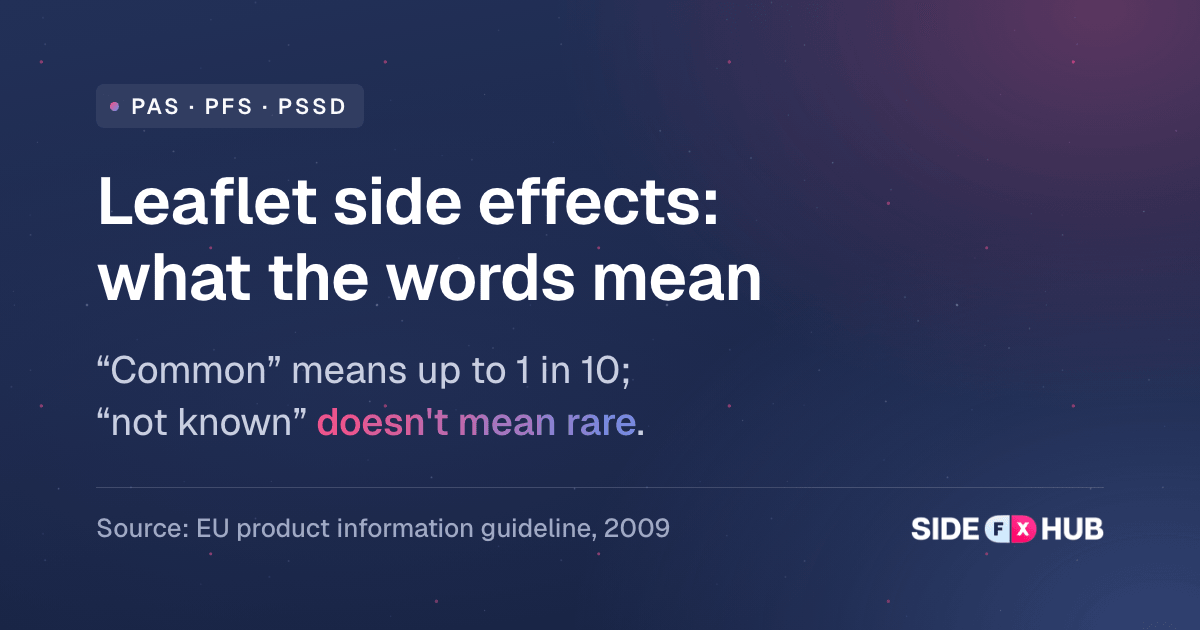
On a UK medicine leaflet, “common” means a side effect may affect up to 1 in 10 people, so most people won’t get it. “Not known” means there’s no figure, and that isn’t the same as rare.
That missing figure matters most for sexual problems that can last after stopping an SSRI antidepressant (such as sertraline), finasteride (for hair loss) or isotretinoin (for severe acne). They’re known as post-SSRI sexual dysfunction (PSSD), post-finasteride syndrome (PFS) and post-Accutane syndrome (PAS). No leaflet tells you how often they last.
All three are more than sexual problems, whatever the names suggest. A checklist doctors and researchers proposed in 2022 puts a lasting change in genital feeling, such as numbness, at the centre of PSSD. It also lists emotional numbing and problems with concentration and memory. With PFS and PAS, depression can come without any sexual problem at all.
The story in 3 lines
- UK leaflets use fixed words for how often a side effect happens, from “very common” to “not known” (EU guideline, 2009).
- “Not known” means the frequency “cannot be estimated from the available data”. It doesn't mean rare.
- SSRI, finasteride and isotretinoin leaflets warn that sexual problems have continued after stopping. For all three, how often this happens “is unknown” (2022 checklist). For SSRIs, a 2023 review found no reliable figure.
Press: contact@sidefxhub.com
Sumair was 21 and a student in the US when an online clinic prescribed him finasteride to put on his scalp for thinning hair. Here he says what he was told before he started.

“Side effects are very rare,” he remembers hearing. He used it four times. Months later he described genital numbness, no sex drive and trouble with memory and focus. Music, he says, now “does absolutely nothing” for him. His story is on our site.
What do “common” and “rare” mean on a medicine leaflet?
Each word stands for a fixed band of numbers, printed in brackets beside it. The scale comes from an EU guideline from 2009, and UK leaflets still use it. The numbers come from studies of the medicine, mostly clinical trials.
The words on a UK leaflet
Studies have found that people think these words mean far higher odds than they do. In one study in Leeds, people taking a cholesterol medicine were told constipation was a “common” side effect. On average, they guessed it affected about a third of people. The figure behind the word was under 3 in 100.
The word tells you how often something turned up in those studies. It can’t tell you what will happen to you, or what happened after people stopped.
What does “frequency not known” mean?
It means nobody can work out a figure from the data available. Some leaflets say “frequency unknown” or “unknown frequency”, which means the same.
These are often side effects first reported after the medicine went on sale. Nobody knows how many people took it without reporting anything, so the reports can’t show how often it happens.
The EU guideline says reports like these must not be used to pick a band. So “not known” is a gap in the counting. It could hold a side effect that turns out to be rare, or one that isn’t.
Does the leaflet say how often side effects last after stopping?
No. None of the UK leaflets we read gives a figure for how often a problem lasts. Each puts the warning somewhere different.
- Finasteride (Propecia): erection, sex drive and ejaculation problems are “uncommon” while you take it. If the same three problems last “after discontinuation of treatment”, meaning after stopping, they’re “frequency unknown”. Only this leaflet lists the lasting problems on their own.
- Sertraline (Lustral): section 2, the part to read before you start, says sexual symptoms “have continued after stopping treatment” in some cases. There’s no band.
- Isotretinoin (Roaccutane): section 2 warns of “long-lasting sexual problems” after stopping, with no band. Section 4, the list of side effects, puts the problems themselves under “unknown frequency”.
- Dutasteride (Avodart), a prostate medicine that works like finasteride: erection, sex drive and ejaculation problems are “common”, each followed by “this may continue after you stop taking Avodart”.
Part of the gap comes from how trials are run. They “do not routinely include follow-up” to see whether sexual side effects go away, say the doctors and researchers behind the 2022 checklist. Our page on what trials can and can’t show explains more.
What can I do?
These medicines help many people. If you have side effects, that’s a decision for you and your prescriber. If you take an antidepressant, don’t stop suddenly. For finasteride and isotretinoin, follow what the leaflet says.
Reading your leaflet: three checks
- Find your side effect in section 4 and read the range in brackets above it.
- Read section 2 as well. On the SSRI and isotretinoin leaflets, that's where the line about stopping is.
- Read “not known” as “no figure yet”. It doesn't promise that something is rare.
If something hasn't gone since you stopped, you could tell your GP: “My leaflet lists this, and it's still here months after my last tablet.”
Many people say it took time to be taken seriously. Bring the leaflet. You can report it without a doctor agreeing. Our page on medicines that can cause sexual side effects shows where each leaflet puts the warning.
Report it: it helps everyone
A doctor’s note helps you. A report to the medicines regulator helps everyone else: it is how patterns get noticed.
- No proof needed. A suspicion is enough, even years after stopping.
- Where: the Yellow Card scheme in the UK, MedWatch in the US.
- Use the right words. For an SSRI or SNRI antidepressant, write Post-SSRI sexual dysfunction (MedDRA 10086208). For finasteride, write Post 5-alpha-reductase inhibitor syndrome (MedDRA 10082430). PAS has no term yet, so say the symptoms continued after you stopped isotretinoin.
Our reporting guide walks you through it

What else do people ask?
Does “rare” mean it won’t happen to me? No. The word describes a group of people, not you. A problem can even be called rare when nobody in the trials had it. The EU guideline then sets its band from how many people took part. With several thousand, it goes down as rare.
Does the band only count side effects the medicine caused? No. It counts everyone in the studies who had the problem while taking the medicine, even people who might have had it anyway. The guideline asks for that plain count, with no comparison against a dummy pill.
What if my side effect isn’t on the leaflet? Tell your doctor or pharmacist anyway: every leaflet we read asks about “any possible side effects not listed in this leaflet”. Read how warnings get onto leaflets, and what’s known so far about PSSD, PFS and PAS.
Sumair was told the side effects were very rare. If something has stayed with you since you stopped a medicine, report it, whatever word your leaflet uses.
Sources
- European Commission, A guideline on summary of product characteristics (SmPC), Revision 2, September 2009, section 4.8. The convention: very common ≥1/10; common ≥1/100 to <1/10; uncommon ≥1/1,000 to <1/100; rare ≥1/10,000 to <1/1,000; very rare <1/10,000. “In exceptional cases, if a frequency cannot be estimated from the available data, an additional category frequency ‘not known’ may be used”, explained as “not known (cannot be estimated from the available data)”. Frequencies “should represent crude incidence rates (and not differences or relative risks calculated against placebo or other comparator)”. “Frequencies based on reporting rates from a spontaneous reporting system should not be used to assign frequency category.” A reaction never observed in trials is banded from the trials’ total size (the guideline’s example: not observed among 3,600 people gives “rare”).
- Propecia 1 mg film-coated tablets, patient leaflet, Electronic Medicines Compendium (EMC 2194), UK, last revised May 2026. Section 4: uncommon (may affect up to 1 in 100 people), erection problems, less desire for sex, ejaculation problems; “Frequency unknown”, “persistent difficulty having an erection after discontinuation of treatment”, “persistent decrease in sex drive after discontinuation of treatment”, “persistent problems with ejaculation after discontinuation of treatment”.
- Lustral (sertraline) 50 mg and 100 mg tablets, patient leaflet, EMC 2835, UK, last revised December 2025. Section 2, “Sexual problems”: “In some cases, these symptoms have continued after stopping treatment.” Section 4: ejaculation failure very common; decreased sexual interest and erectile dysfunction common; “Not known: frequency cannot be estimated from the available data”.
- Roaccutane (isotretinoin), patient leaflet, EMC 100633, UK, last revised April 2026. Section 2: “There have been reports of long-lasting sexual problems where the symptoms have continued despite stopping treatment with isotretinoin.” Section 4, “Unknown frequency: (frequency cannot be estimated from the available data)”: erection problems, lower libido, vaginal dryness, orgasm difficulties, reduced sensation in the genitals.
- Avodart (dutasteride) 0.5 mg soft capsules, patient leaflet, EMC 6758, UK, last revised March 2026. Common (may affect up to 1 in 10 men taking Avodart): erection problems, decreased sex drive, difficulty with ejaculation, each followed by “this may continue after you stop taking Avodart”.
- Healy D, Bahrick A, Bak M and colleagues. Diagnostic criteria for enduring sexual dysfunction after treatment with antidepressants, finasteride and isotretinoin. Int J Risk Saf Med 2022;33(1):65-76. Proposed criteria from expert agreement. The incidence of these conditions “is unknown”. Clinical trials “do not routinely include follow-up to assess the resolution of adverse sexual effects”. PSSD ancillary symptoms include emotional numbing and cognitive impairment; with finasteride and isotretinoin, cognitive impairment and depression “can occur independently of any sexual difficulties”.
- Tarchi L, Merola GP, Baccaredda-Boy O and colleagues. Selective serotonin reuptake inhibitors, post-treatment sexual dysfunction and persistent genital arousal disorder: a systematic review. Pharmacoepidemiol Drug Saf 2023;32(10):1053-67. “It was not possible to determine reliable estimates of prevalence.” Read as the abstract.
- Knapp P, Raynor DK, Berry DC. Comparison of two methods of presenting risk information to patients about the side effects of medicines. Qual Saf Health Care 2004;13(3):176-80. 120 adults taking a statin, cardiac rehabilitation clinics at two Leeds hospitals. Constipation described as “common” or as 2.5%: mean estimates 34.2% (word) and 8.1% (number). Read as the abstract. The same team found people overestimated the EU words in every study they ran: Berry DC, Raynor DK, Knapp P, Bersellini E, Drug Saf 2003;26(1):1-11 (abstract).
- Moral Medicine, Just 4 Doses of Topical Finasteride Changed His Life, interview with Sumair, 6 April 2023 (the title is the channel’s). Our page plays 3:09 to 3:56. What he was told: side effects “very rare” and expected to go once he stopped (3:10 to 3:22). Four applications (3:37). Symptoms when filmed, about four and a half months later, including numbness, no libido, memory and focus problems, and music that “does absolutely nothing” for him (8:09 to 9:52). Quotes from the YouTube captions.
- NHS Black Country, What is the Yellow Card Scheme?, Medicine Safety Week, 4 November 2021. Background only.
Sources checked on 27 October 2026. AI-assisted writing and review, not clinical review.
This information does not replace medical advice. Talk to your doctor before you make any decision about your treatment.
640+ people have joined the registry.
Join them, then report your side effects.
Free. Sign up takes 2 minutes.